Christmases Past - Part 2
Australian Christmases with a Husband born in Germany
And Five Fun Facts you didn’t know about Australian Christmas
My second Christmas phase of customs came when I got married. Christmas evolved into a blend of our own personal flavour. Like with marriage, it was something we defined as we went. This phase of course included the arrival of our two children.
And yes, my husband was a Hamburger – born in Hamburg in Germany.
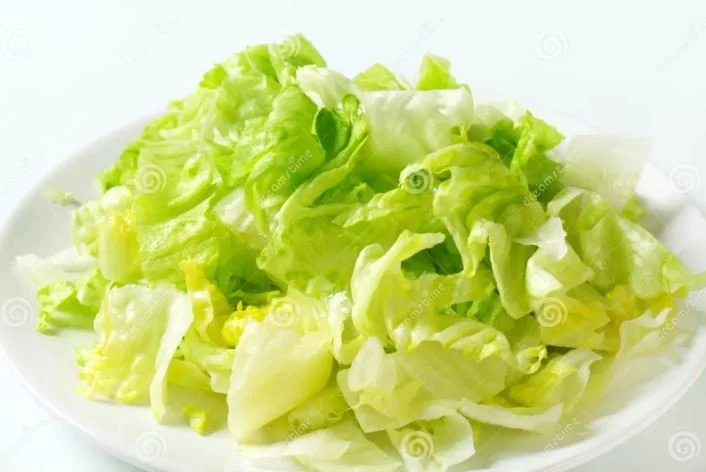
Australia was also evolving as a nation. In the 1970s I grew up in the country with salads of iceberg lettuce, standard tomatoes and the big cucumbers I’ve never liked, doused in the all-new and fancy “Italian Dressing” from a bottle which tasted more like cardboard than any known food varieties. I had never heard of mangos or avocados. By my Second Phase of Christmas it was the 1990s. By then there was an endless variety of fresh foods and flavours available, especially from Asian cuisines. Australia was also growing up in terms of Christmas.
Christmases Past – Phase 2 – My Husband was Born in Germany
This is extremely common in Australia. More than half of all Australians were either born in another country, or have at least one parent who was.
There was a major push for immigration during the labour shortage of post war Australia. In the 1950s and 1960s the government subsidized boat tickets to encourage Europeans to emigrate to Australia.
The Italians and Greeks were a huge proportion of the ones who took this up. In fact, the third biggest Greek city in the world is Melbourne – after Athens and Thesaloniki, there is a bigger Greek population in Melbourne than any other city, including in Greece! There is even a distinctive Italian-English accent – Italians born in Australia who are native English speakers have a slightly different accent to the other Australian accents (probably influenced by the Italian speaking environment they get at home).
But they weren’t the only immigrants. My husband’s story is very typical. At the age of 2, he came to Australia with his family in 1959 on a boat that took 6 weeks. Their first home was a garage as they launched on the challenging task of assimilating into their new home.
As we started our own family, I embraced his German past by adding some German customs to a Christmas that became a blend of both our pasts.
The first step was making an Adventskalendar when our first baby arrived. Today this is now something done typically by everyone and very commercialized. Some are very fancy, with a daily mini Lego to make, exotic chocolates, or other variations around everything in popular culture today.
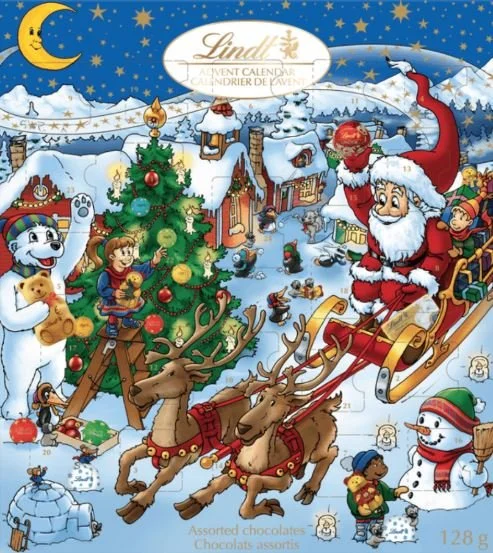
Typical chocolate calendar. Maybe they are now far removed from the original German one, but they are still fun!
But the original Adventskalendar was just a flat one with windows, each one with a small poem that was part of the Christmas story – much like in Bad Santa. My version was stitched over the head of our 1-month-old son, a Christmas tree to hang flat on the wall, made up of very flat pockets with the numbers.
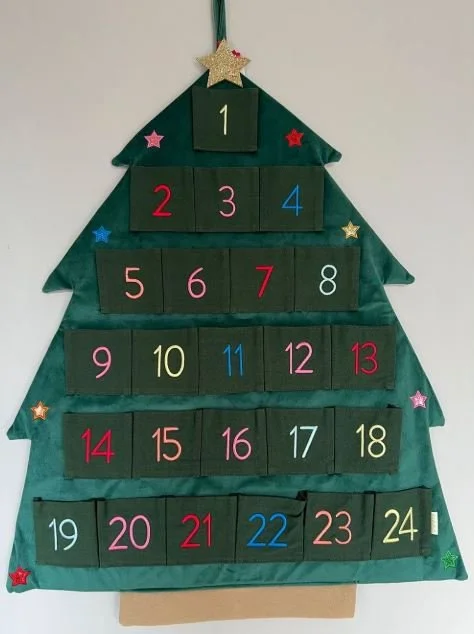
Something like the one I made, but mine was pretty - flat red heart shaped pockets of red Christmas material on green Christmas material squares, with the numbers arranged randomly.
This then presented the problem that I wasn’t keen to have the day being started with a chocolate, or just dishing out coins for my toddlers. When he was old enough (the two of them in time), I turned it into a treasure hunt. In each pocket (too flat for any ‘thing’) I put a piece of paper with a mini treasure map and X to mark the spot – somewhere around the house where I had hidden a small treat. (As they got old enough to read, the picture turned into a puzzle for them to solve).
The treat was some dried fruit wrapped in pretty see-through cellophane paper tied with fine coloured ribbon. The big prize came on Christmas Day. To find this prize they had to follow a whole trail of clues hidden around the house. The treasure? A breakfast bowl – the mini cereal packets loaded with dried and fresh fruit and nuts, topped with a whole mango each, even when they were very little!
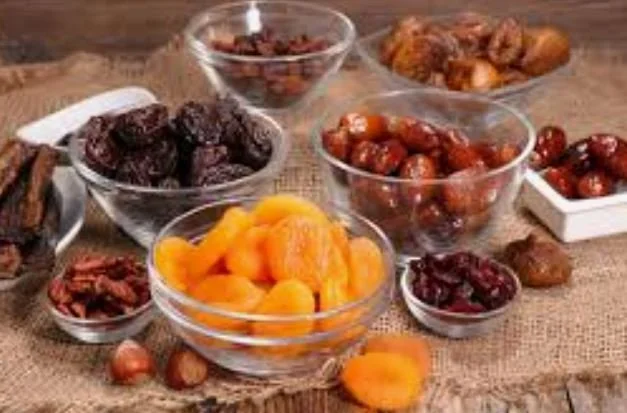
Dried mango is still a favourite for all of us today.
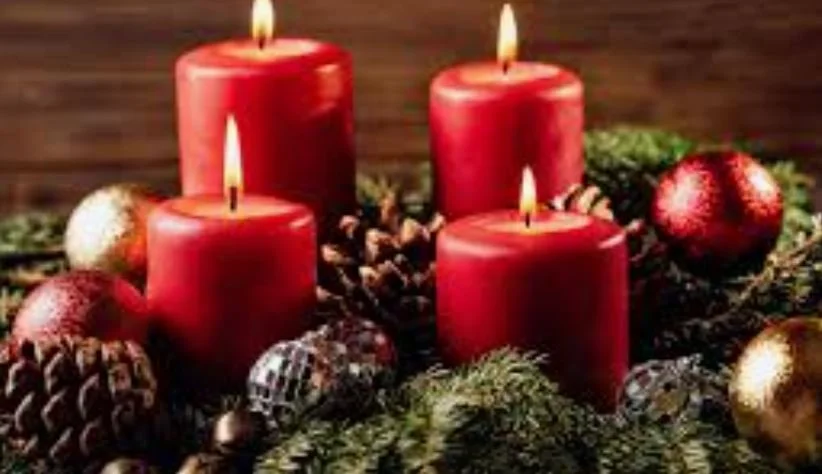
We also had an Adventskranz on our dinner table. This is an evergreen wreath, with 4 candles set around it. The first week of Christmas one of the candle is lit daily, the next week two of them. Then three, and on Christmas day all four are lit.
I also made some major adjustments to our Christmas dinners. It is now very typical for Australians to vary the traditional hot Christmas roast with colder dishes, BBQs in the evenings and especially Christmas Eve, but not many people did it back then.
Our traditional meal became a chicken and baby tomato salad with a sour cream, mustard and chutney dressing (a creation of a close friend who was a chef), huge plates of freshly sliced ham off the bone with mango slices and cherries (summer fruit!), bowls of prawns to peel, crusty fresh bread, salads and hot baby potatoes in butter and herbs. My favourite of the deserts was plum pudding ice-cream – the fruit and nuts of the plum pudding in ice-cream heavily laced with cherry brandy – and a jelly full of summer berries and made with champagne, bubbles set in the jelly mold (a Jamie Oliver recipe).
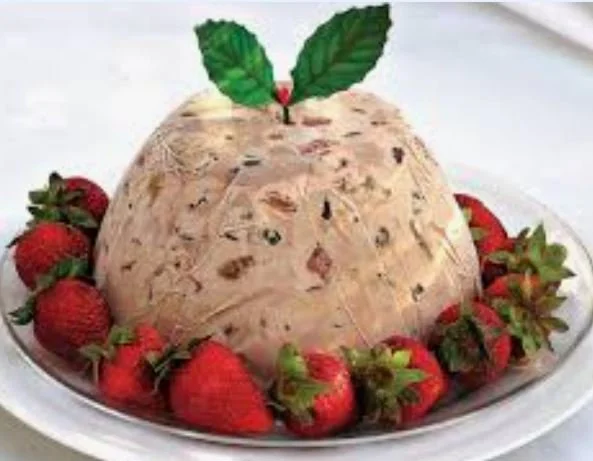
Plum Pudding Ice Cream…
…and Champagne Jelly
I even extended the foods by making boxing day lunch one for home made sushi, to share over some small mini gifts for a gentler let-down from the intensity leading up to Christmas.
The kids went to an Aboriginal pre-school, then elementary/primary school where I was teaching (The Minimbah School in Armidale). This added a whole extra spin to Christmas. Santa was black – and not from chimney soot – and the lunch foods included emu and crocodile burgers.
My very close friend at the time (and my daughter’s godmother) was a Chinese student from Hong Kong. Although Australia doesn’t have the specific Christmas biscuit or cookie thing like America (which doesn’t have a specific cake), I thought it was a fun idea. My friend and I would spend December cooking a selection of biscuits out of the Women’s Weekly Biscuit book – an excellent list of recipes.
The must-cook every year was Biscotti. The word is Italian and means biscuits in general. But typically when a word swaps languages, its meaning also morphs. This particular is an Italian one – in fact, I have found versions of it all around the Mediterranean. Morocco’s is more savoury, but a yummy version with cummin, seeds and nuts.
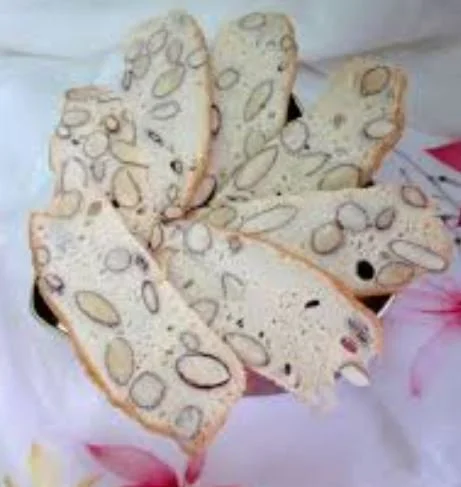
Biscotti with almonds
It is a twice baked biscuit. That is, the first cooking is a slow bake – predominantly egg whites like meringue with a lot of flour, plus lots of dried fruit and/or nuts and seeds. I loved the dried apricots, glace cherries and almonds or walnuts, and also the one loaded with sunflower and sesame seeds and caraway seeds (and less sugar). For the second, you cut the loaf into ¼ inch ½ cm slices and bake again til browned.
Other favourites included a version of gingerbread jam drops, savoury cheese twists, and almond meal-meringue stars.
The German part of our lives also had an impact. My husband’s sweet tooth was a fan of pfeffernusse, a popular German biscuit – gingerbread drops in a very light icing. And even more favourite, Stollen. As a major fan of marzipan, we both loved this dense white fruit cake with a filling of marzipan and covered in icing sugar.
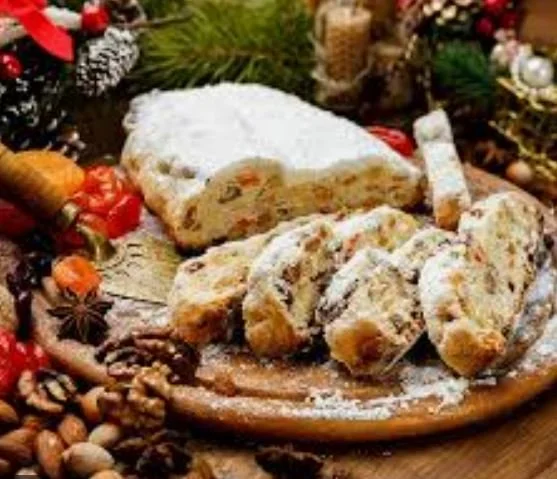
Marzipan Stollen
Just like our family ‘traditions’, Australia was also evolving. Here are 5 fun facts about Christmas in Australia. How many of them did you already know? (Aussies aside)
Fact 1: Santa
By this time, Australia was starting to recognize the incongruency of its cold weather Christmas customs with its climate and season. Even though Santa was mostly dressed in his red suit, cold weather boots and hat with furry trimmings, he also started appearing in board shorts and on a surfboard – something maybe in common with places like California and Florida. But the Aussie version sometimes also came with a bunch of kangaroos leading him instead of the classic reindeer.
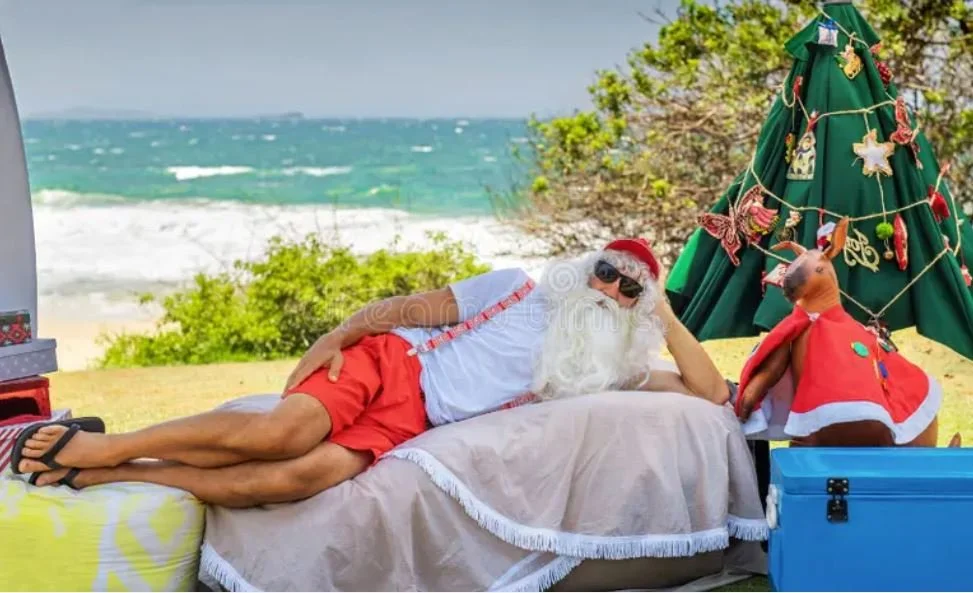
Santa is on a break
Fact 2: Christmas in June
Since Christmas was normally a winter festival, sometimes you can find Christmas festivities on the 25th of June, exactly 6 months later and in the dead of winter. It is usually just a night of party and Christmas foods, a bit of Christmas cheer in the winter. Actually, I think it is more just an excuse for a party, because, well – why not.
Fact 3: End of School-Calendar Year
Unlike the northern hemisphere where Christmas is just the middle of the winter, in Australia it is also the end of the school year and the summer holidays. It is actually a crazy time of the yea, especially with kids. There are end-of-year work parties, of course. Some professions means partings – teachers, lecturers and bankers often move at this time. Then there are end of school year activities – the classroom, any activities kids are involved in – my kids had music events, but there was something for all activities from guides and scouts up to major dancing and singing concerts. Schools have end of year concerts and graduations. And don’t forget to throw in beach holidays and crossing the countryside to visit family members. Basically – everything thrown in at once.
Fact 4: Christmas Bush and Christmas Bells
Yes – you’ve got it. Australia has a Christmas Bush, and Christmas Bells, not just something labelled that, like the Christmas tree, but plants with those names. As you might expect, they are ones that come into flower at Christmas time, and are a vibrant red, of course.
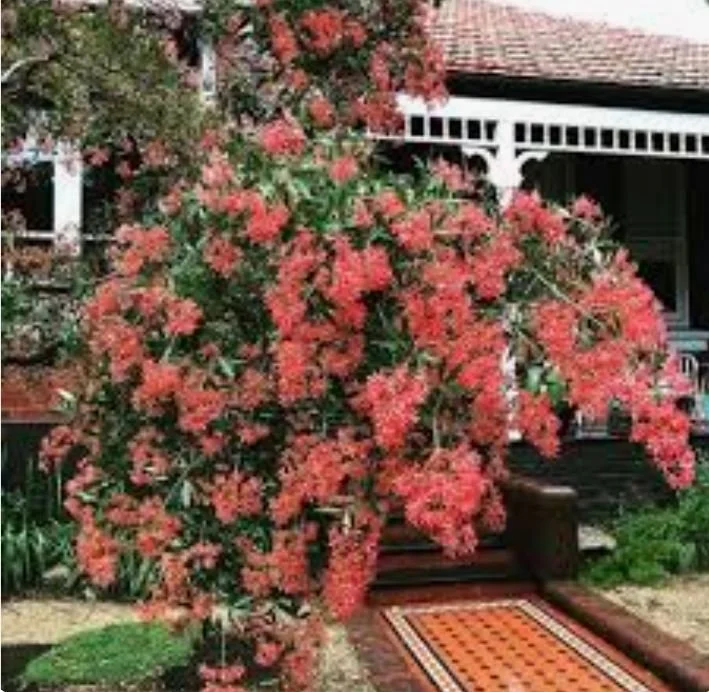
Christmas Bush in front of a classic Federation style house, maybe built in the 1920s.
Because of the hot dry climate, most plants are open, flowers are small, and their root system is usually shallow and spread out to take as much water as they can when it rains.
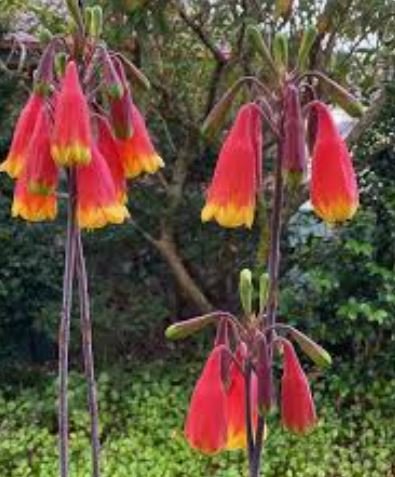
Christmas Bells
Fact 5: Christmas Island
We even have a Christmas Island. It’s not a neighbour to Easter Island off the west coast of South America. It’s actually very close to Indonesia. For this reason it was a popular place for refugees to cross to ask for asylum and has had refugee camps for a long time. For this reason a more obtuse government redefined it in the constitution as “not officially Australia”. (Now refugees are unceremoniously offloaded to other countries for a fee, especially Nauru in the Pacific).
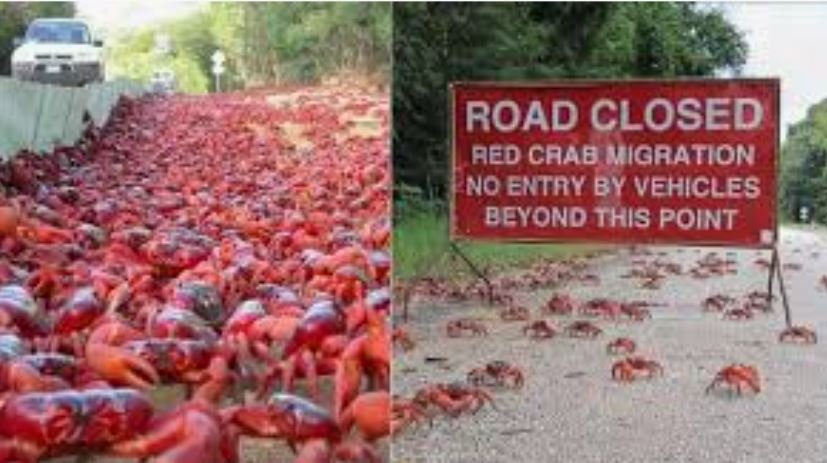
However, Christmas Island is Australian territory, and a delightful little tropical spot a long way off the coast of Western Australia. It’s unique characteristic is the Red Crabs which migrate across the island every year around Christmas time – the babies crossing from one side to the other. There are so many of them the roads turn red. It must be one of the bizarre natural phenomenons that our world is so full of, and one very worth observing if ever you get the chance.