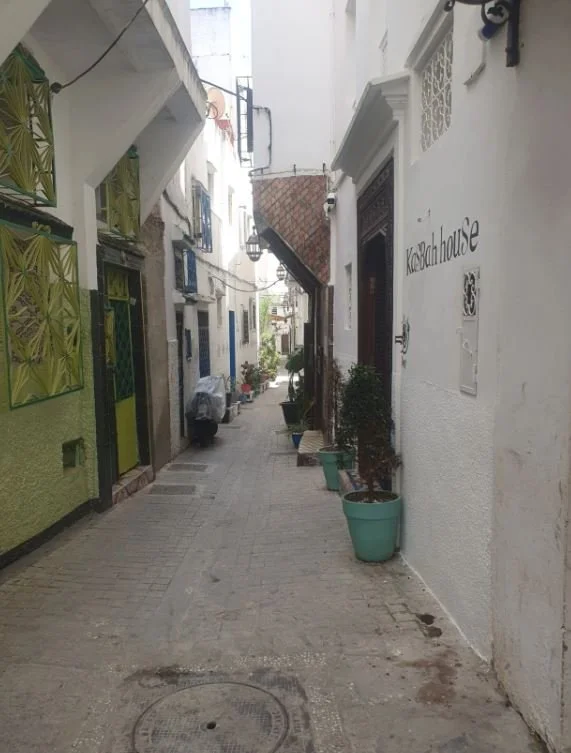
10 Things to do in Tangier –The Medina
10 Things To-Do in Tangier Medina
Tangier is often bypassed by tourists, a ferry stop at most as they rush past to Marrakech and Fes. To be honest, I’m not even sure if I’d heard of Tangier before I went there. But I will excuse me for that – Australia is so far away.
Casablanca has a name only because of the movie – which wasn’t even filmed there (all on set in Hollywood). And Marrakech – just one of those heard of places to visit, end of the Sahara, resting and trading station and camel mecca.
But if you find yourself passing through Tangier, stop for a little. Everyone I have talked to wishes they had stayed longer.
It has as much colourful history as Marrakech. Marrakech might be the gateway to the desert. Tangier is the gateway to Europe. It was an International Zone for three decades (1923-1956) administered by up to 7 nations at one point. It attracted the frustrated and rebellious from conservative Europe, including the likes of Yves Saint Laurent and Jack Kerouac – a habit that continues even today with movie stars and the likes of Mick Jagger.
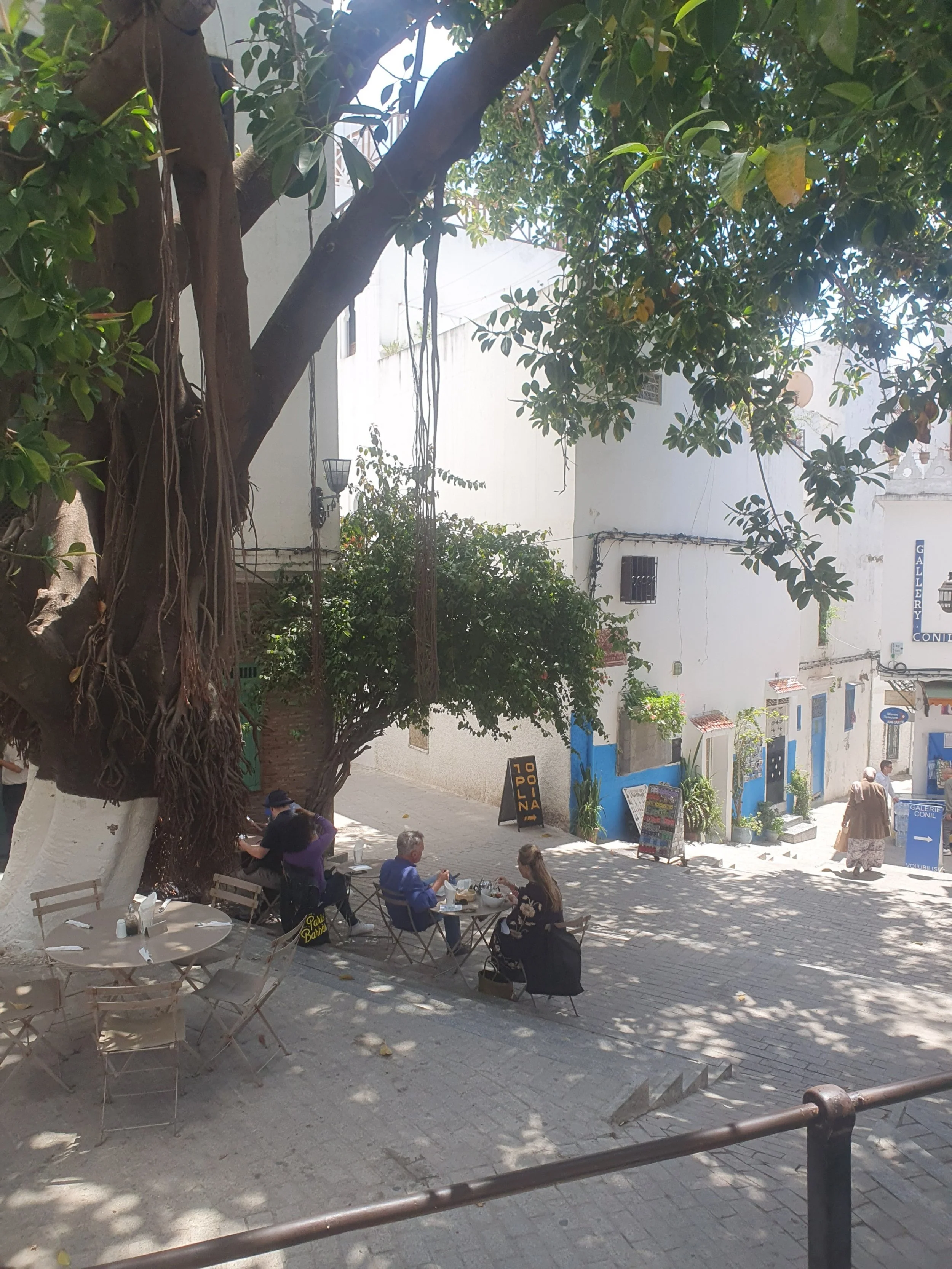
Stop just inside Bab Kasbah (Kasbah Gate, at the top) for a drink under this lovely old spreading tree and watch local life mixed into the nooks maze of alleyways.
What is a medina?
Medina simply means city centre, but it is usually used to refer to the old town, and typical all around the Mediterranean as well as in the Arabic countries. Fes medina is the biggest medina in the world, and the largest un-motorised city centre.
A medina is typically full of a narrow maze of streets designed that way to confuse the enemy – and tourists, with few distinctive features to distinguish what part of town you are in. There aren’t even windows to look into so an enemy can’t get clued into where they are within the walls.
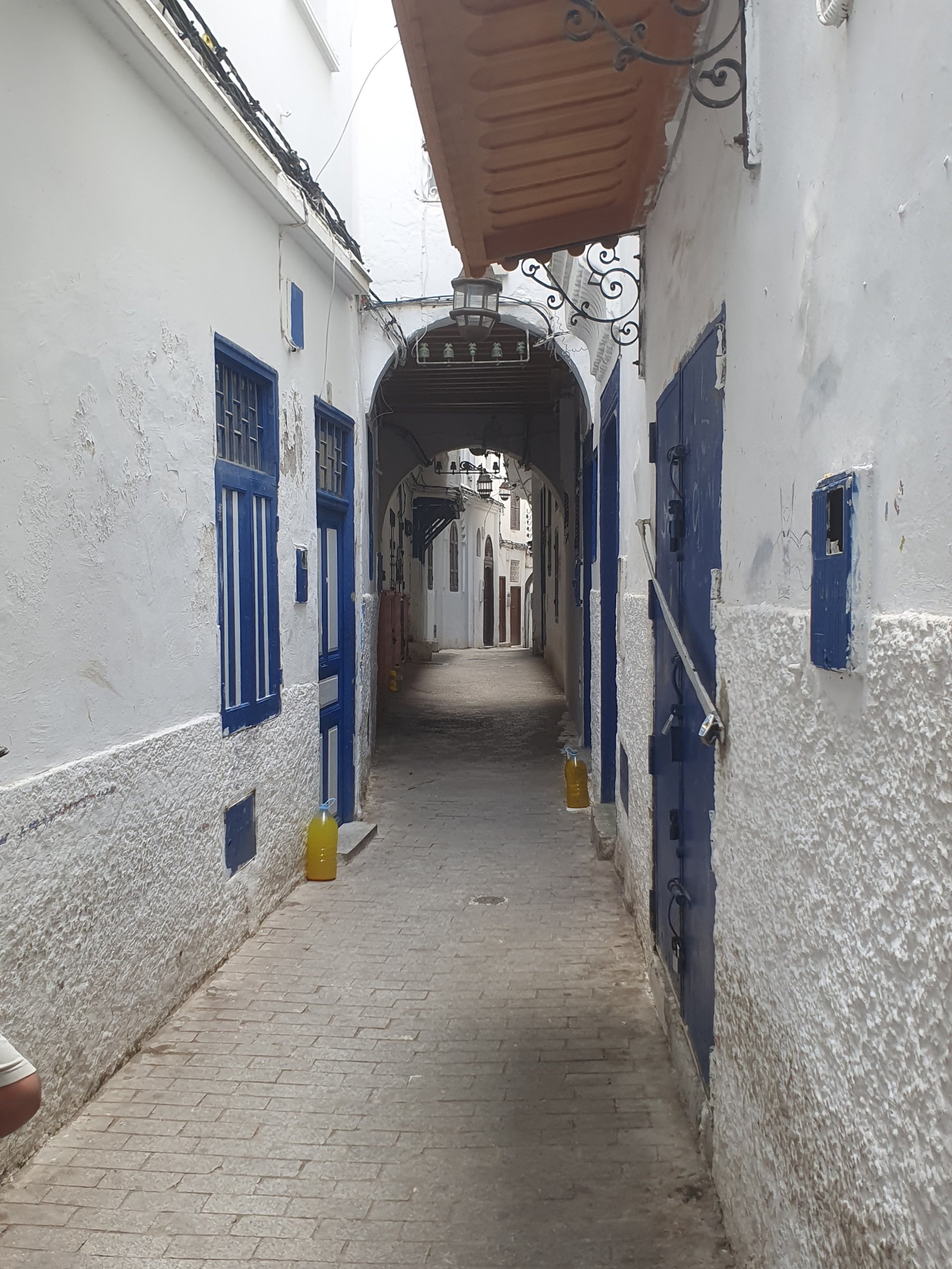
Every street and corner has something new.
So, what is there to do in Tangier in and around the medina?
1 Breakfast and the Corniche
If you haven’t had breakfast supplied by your accommodation, head down to the Corniche. This is the big road at the bottom of the medina that runs from the ferry terminal along the beach to Malabata. There are several cafes (around Café California) which have cheap breakfasts in a nice location on the square. Watch the seagulls around the fountain while you eat.
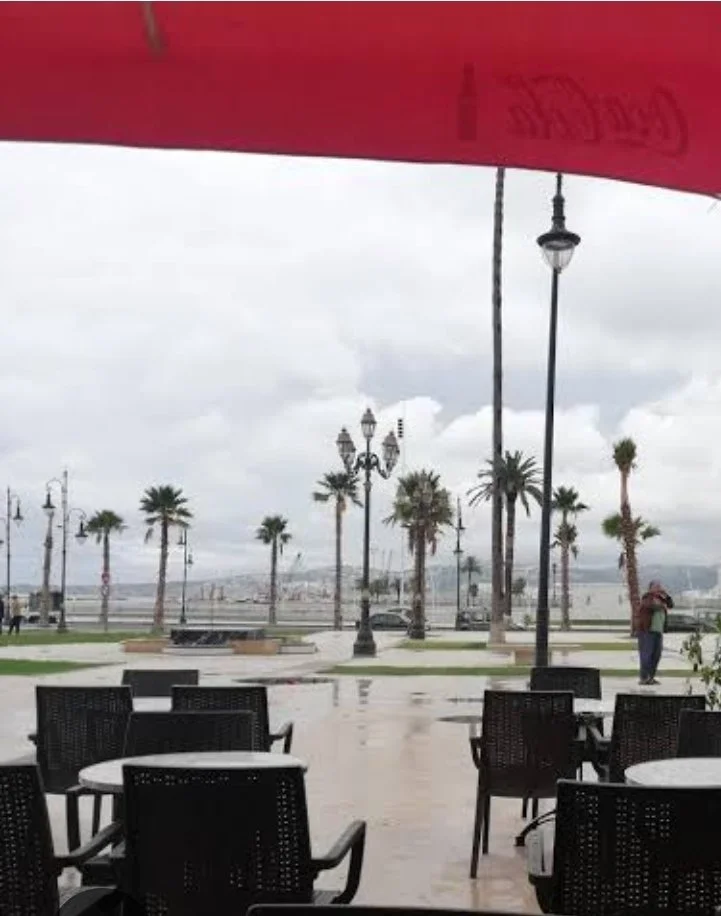
On a rare rainy day with the plaza in front of Cafe California on the Corniche shiny and reflective. Usually the fountain would be splashing, and seagulls would be strutting around it.
If you want a fancy treat, there are many options including the Continental Hotel overlooking the ferry port, or the El-Minzah which also has a great view, between Cinema Rif and Gran Café du Paris. Its walls are covered in photos of the rich and famous who have already eaten breakfast there.
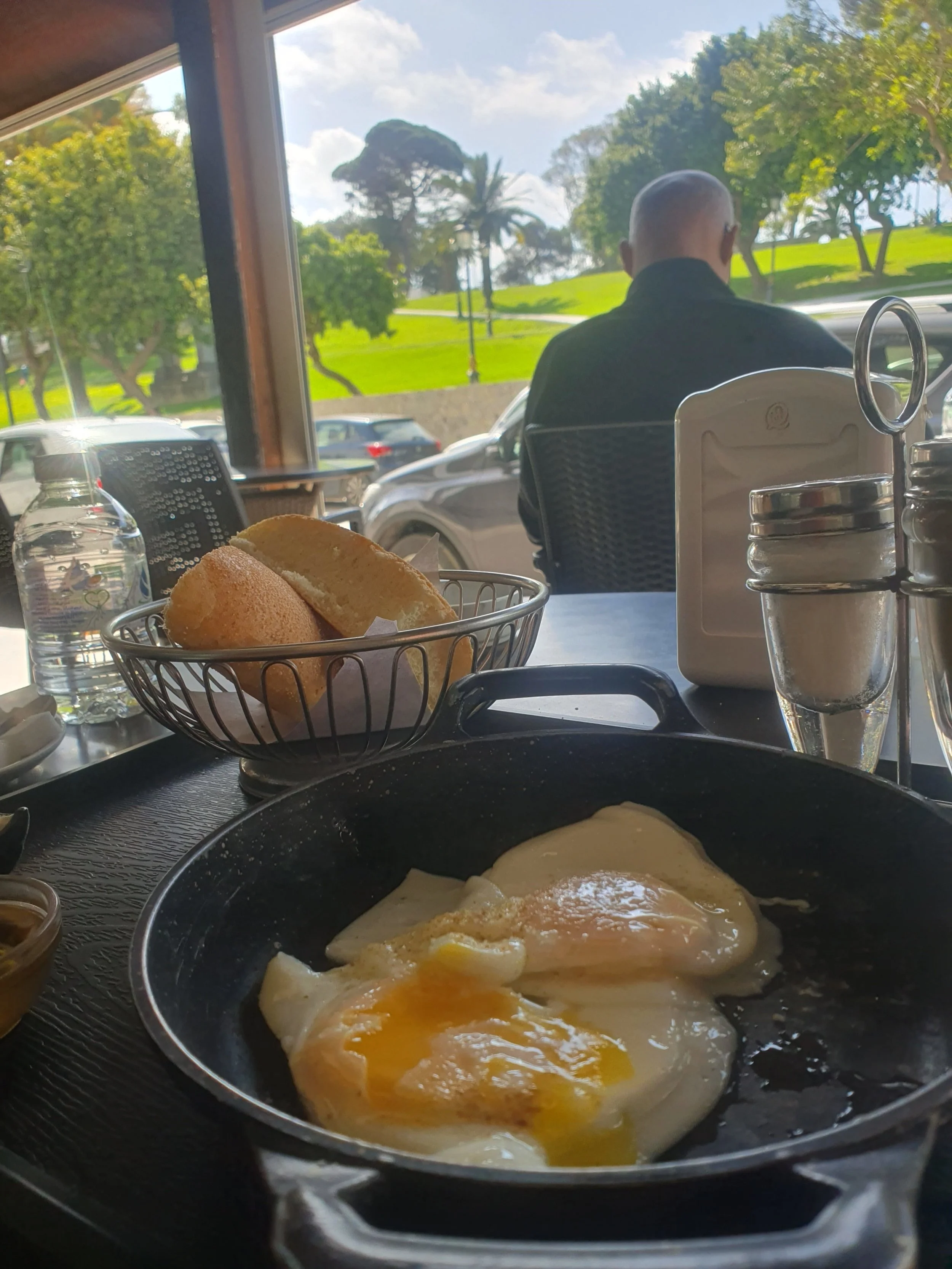
A cheap but more basic breakfast at Cafe Riad al Madina, looking across to the German cemetary. Add Moroccan cheese (like cottage cheese), olives and a hot drink for the basic one, and eggs to your liking (you can’t go past a cheese omelette). Upgrade your breakfast and add a little orange juice, a pot of yoghurt, a salad… It is a very decent breakfast.
2 Get lost in the Tangier Medina
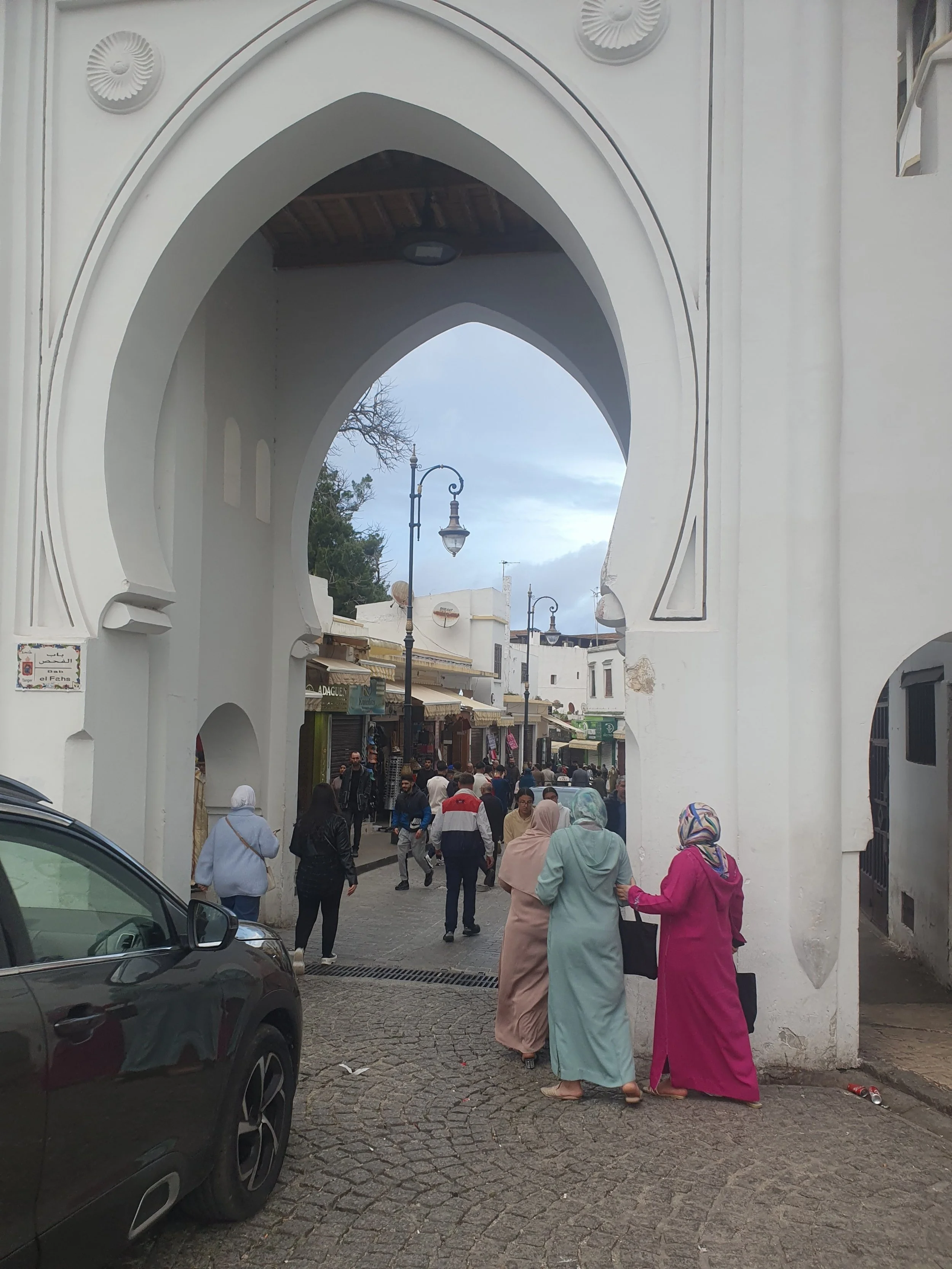
Get lost. This is the best way to explore the medina. Wander around the maze of shops and alleyways. You can shop for ceramics, cloth, silver, rugs, jewellery, antiques, traditional tagine pots, spices, or argan oil. There is endless colour and surprising corners, shops run by friendly local sometimes ofereing tea and a chat. My favourites are the bowls and bright cloth.
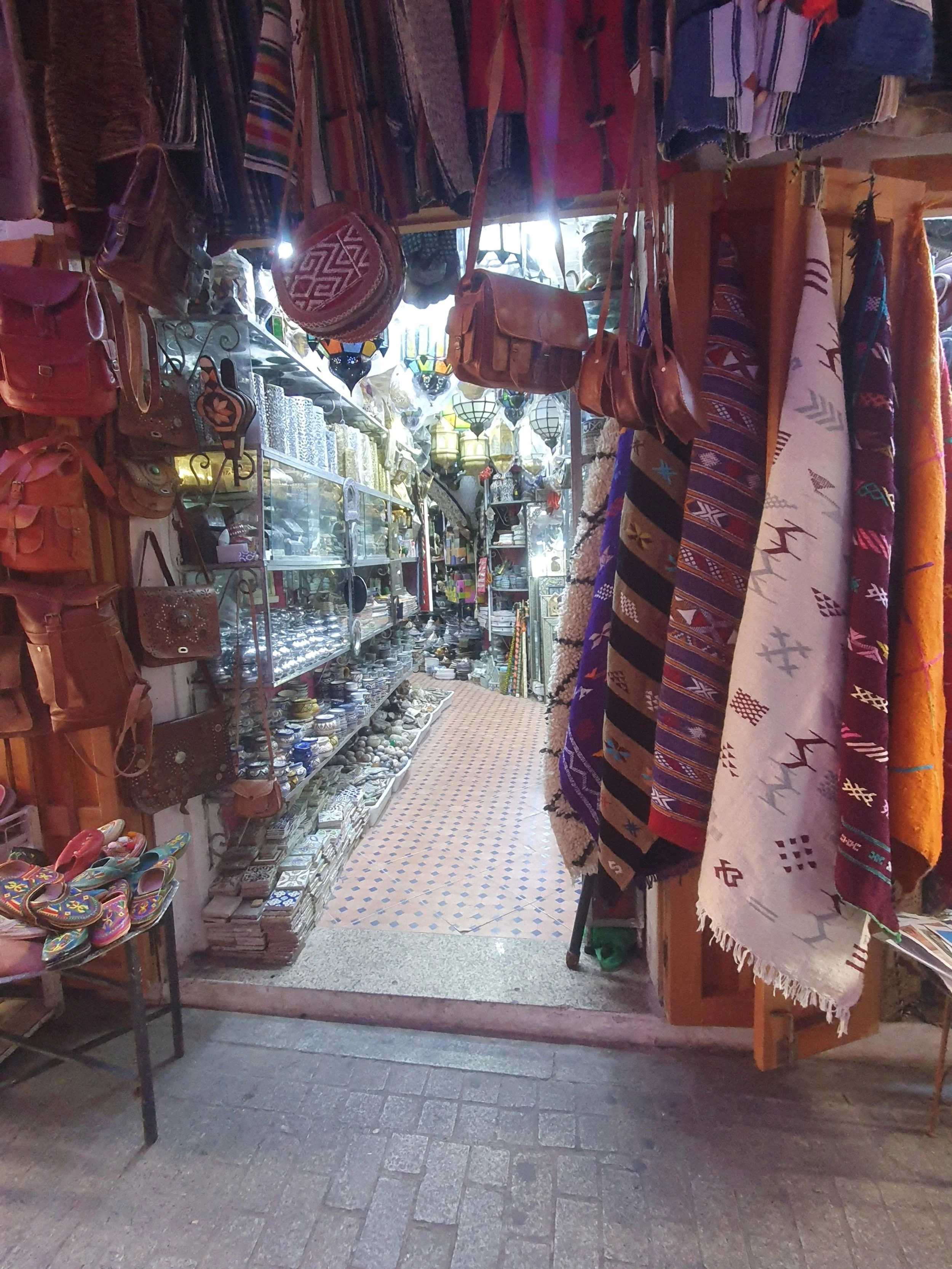
If you’re a window shopper, there is plenty to browse around - add jewellery, antiques, colourful pottery, spices…
The locals are friendly. They will say hello and ask where you are from – just plain old curiosity. Of course they are hoping to sell you something, but they are just as happy to say hello and chat. The rug shops will often offer a friendly glass of tea with no obligations.
A gate off Rue d’Italie into the magical maze of medina streets…
But don’t just hang around the shops. Many people live in the medina. If you explore beyond the main tourist-oriented streets you can discover where the locals buy their meat, fish and vegetables, or get their clothes fixed. When you’re done, there’s always someone friendly to point you back to the Kasbah or Petit Socco and Grand Café Centrale or Cinema Rif.
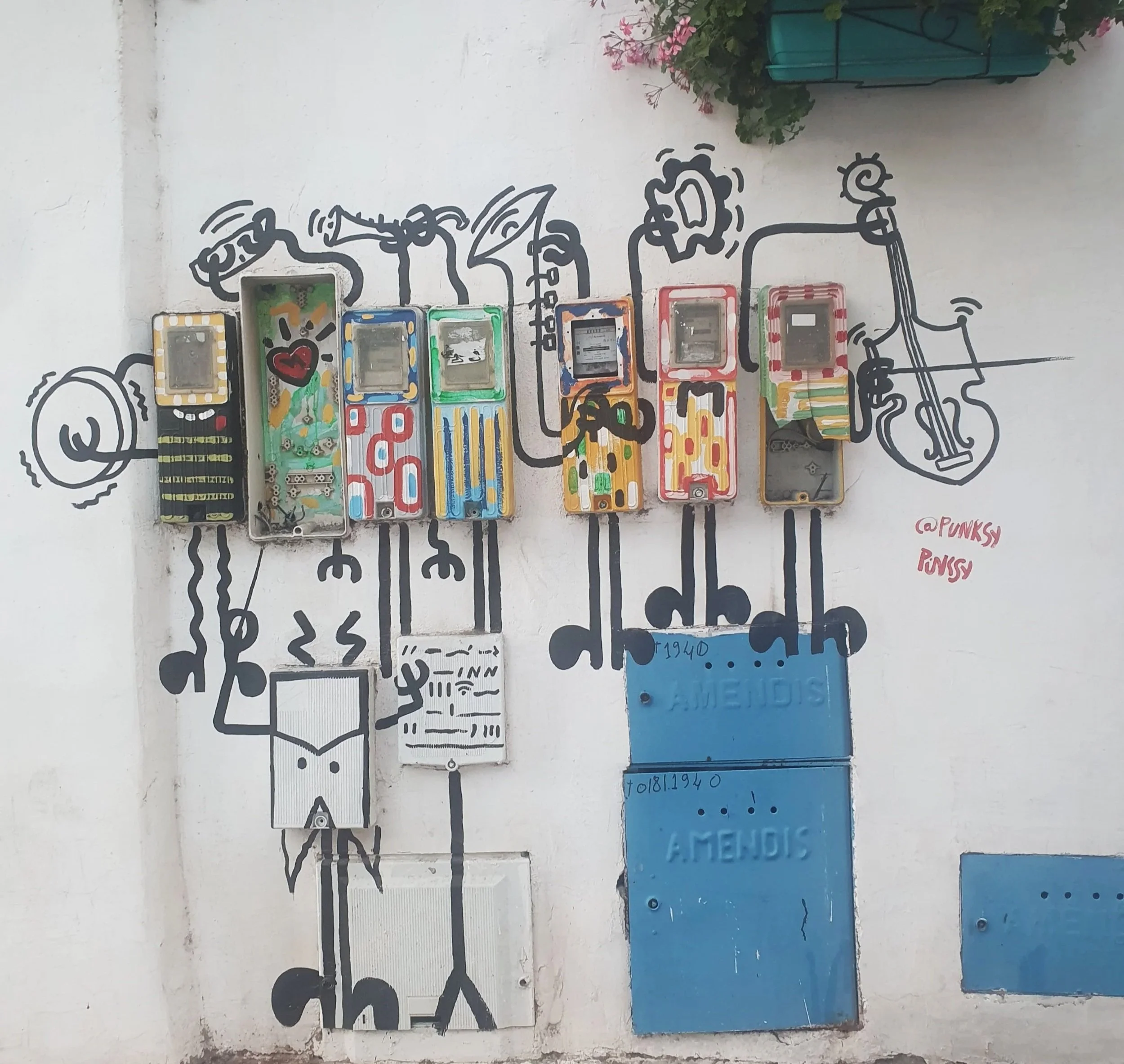
Meters painted by local artist Punksy.
3 The American Legation
For an insider view of what’s behind those alleyway walls with no windows, head to the American Legation near the Spanish Steps. This is now a museum, but it was the first American embassy ever. Morocco was the first nation to recognize the newly independent USA in 1777.
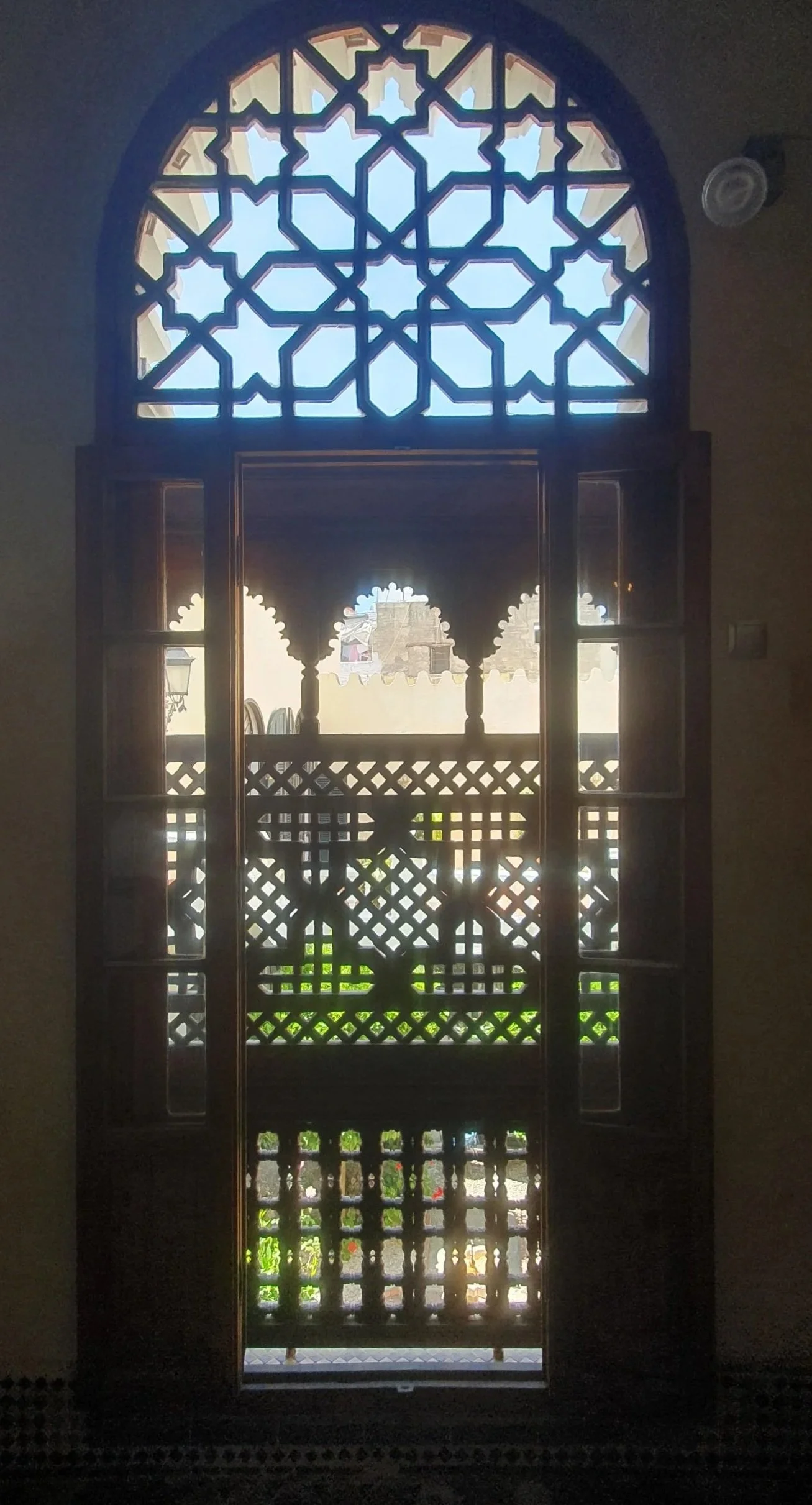
View from the Legation out through one of the decorative windows to the garden - see what might be behind those blank medina walls.
The Legation has interesting exhibits on Tangier history, and historical figures, especially including Paul Bowles who was an American writer and musician and who was the first person to start recording Morocco’s Gnaoua music. You can also get a peek into what a grand home might be like behind those blank medina walls.
4 Bab Kasbah, the Sea Gate and Interzone
Head up to the top of the medina to Bab Kasbah – the Kasbah Gate. Kasbah is the word for castle. Follow the wall around from the gate past some designer boutiques and Morocco Club. Follow the wall around to the next gate – Bab Bhar or the Sea Gate. This is on the square in front of the Kasbah Museum.
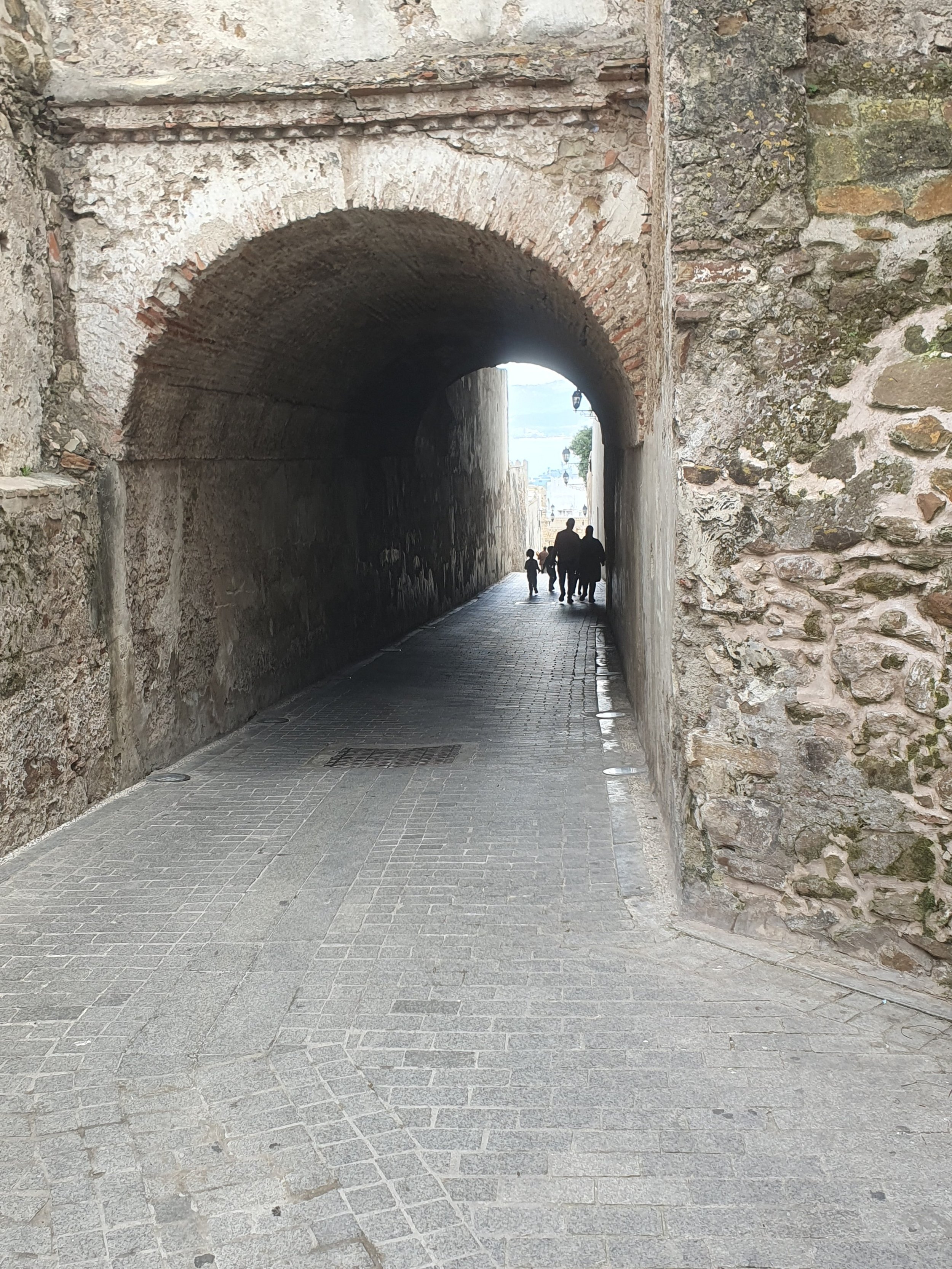
Through this tunnel tunnel in the medina you have Bab Bhar (the Sea Gate) on your left, and the Kasbah Museum on your right.
Check out the view from Bab Bhar – all across the sea to Spain. Salon Blu is just one of the spots where you can stop for a drink and a view and something to eat. The Kasbah Museum has interesting Tangier history. Right next to is a music shop. That is to say, you can sit there and are likely to have a show of local music.
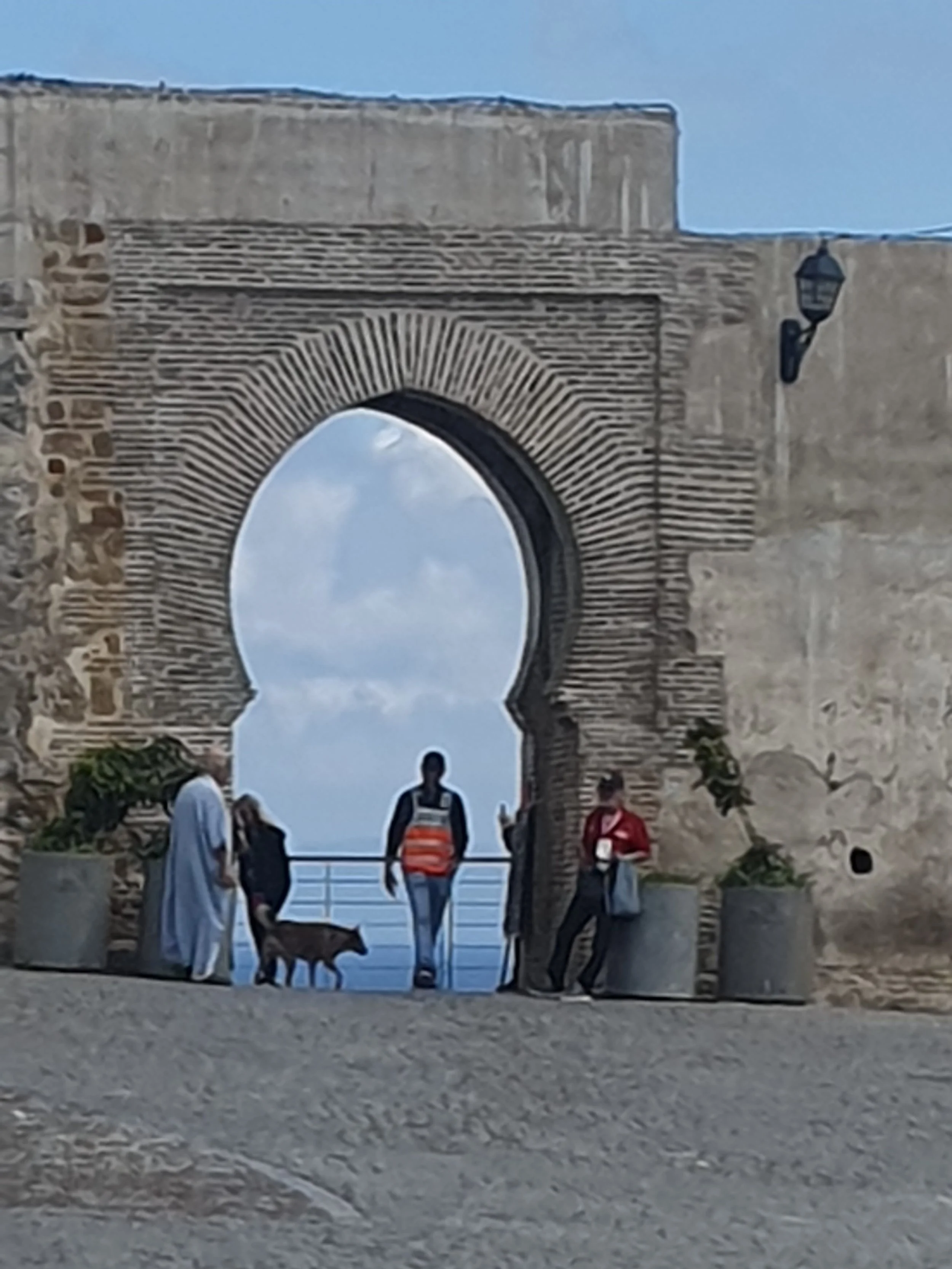
Bab Bhar, the Sea Gate. Sit at one of the cafes around here for a tea with unparalleled views.
Nearby you can also visit Interzone which is part shop and part museum, and has a great collection of movies and writing connections with Tangier. Believe me, there are a lot – without even exploring the local ones.
5 Café Hafa and the Phoenician Tombs
Another iconic spot in Tangier is Café Hafa, famous for its exceptional view across to Spain. You can sit there over a mint tea to while away some time. Watch the ferries, or catch a Hafa sunset.
Just before you get to Hafa, there is a road with some ancient columns on your right, an information board at the entrance. Besides another excellent view of Spain and the Mediterranean, and across Tangier Bay, there are some graves carved into the top of the cliffs. These are some of the Phoenician tombs scattered around the area. Definitely a grand view for a burial!
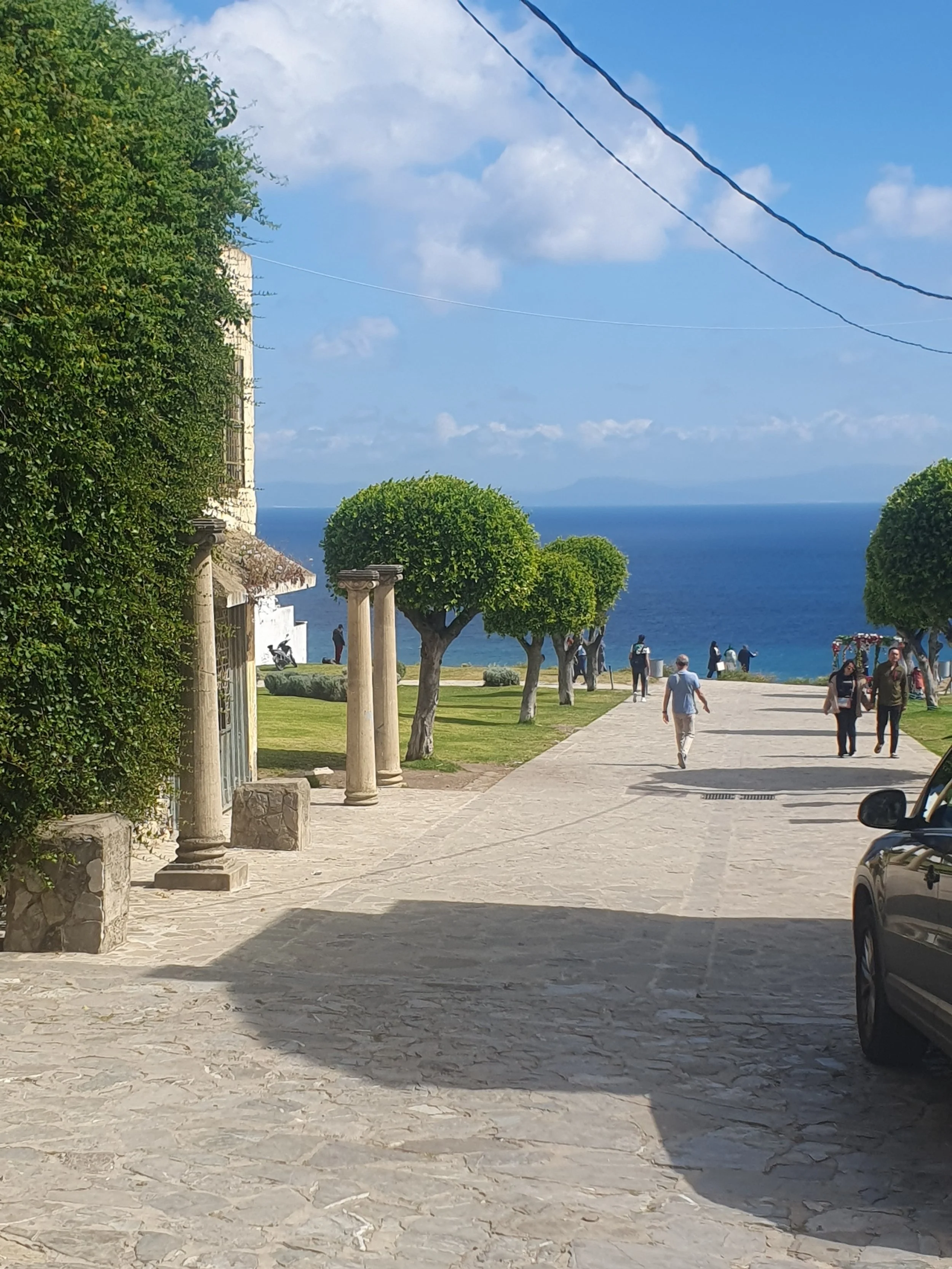
The Phoenecian tombs cut into the cliff top, with fantastic views of Spain (to the left) and Tangier bay.
Across from Hafa and the tombs, there is a nice green park full of cafés – Hanafta. I have a spot at the end of the first café where I can see the sea and Spain across the top of the Phoenician tombs, as well as taking in the park and plenty of Moroccan local life with the variety of people who prefer this park for a tea and snack.
If you are interested, walk to the far end of this park. Here you can see the imperial palace where I believe the king and royal family stays when in town.
6 Chilling in a Café
Walk back down the steep street that runs alongside the outside of the medina wall. This is Rue d’Italie. One of the best pastimes is to line up in front of a café front wall, sip a coffee or mint tea (fresh mint), and to “meditate” as you watch life passing by on the street.
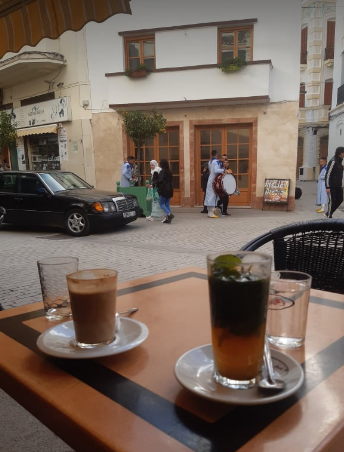
View of Cine Alcazar from Cafe Colon, with cafe latte and Moroccan mint tea to help watching the world pass by.
Café Colon is a meeting point of many of the famous and infamous in Tangier over time, opposite Cine Alcazar. Through the gateway at the end and across the fountain there is also Cinema Rif – a nice spot for the same purposes. Don’t worry that the cafés seem dominated by men. There is no taboo. Women just gather to gossip in different places.
7 Souq Barra and Markets
On your way up to Cinema Rif, through a doorway to the left off the square with the fountain, you can explore the food markets where the locals shop. Check out the spices and the varieties of breads. I have counted more than 20 varieties of marinated olives in one of the tiny shops. Taste them and buy some, or maybe some pickles. And don’t forget my favourite – if you can handle spice. Harissa. There is both red harissa, and green harissa. Every shop has their own recipe.
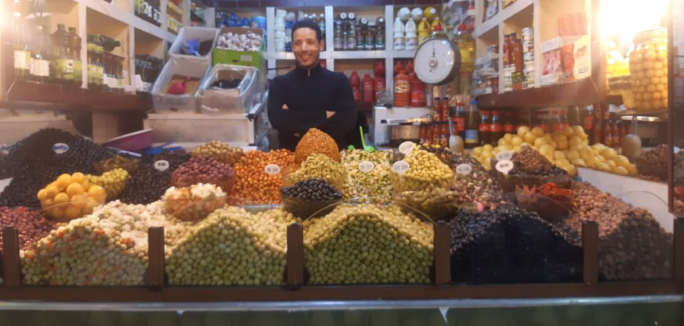
Varieties of marinated olives in one tiny shop. How many different ones can you count?
Walk through the souq down past the ladies from the mountains with their red and white striped ‘skirts’ selling jben (yoghurt buttermilk) and Moroccan cheese wrapped in leaves (like ricotta), the small shops, bread varieties and the meat. Can you identify all of the body parts? I’ve tried all of them, although I don’t know what some of them are for! If you go all the way you will find the fish market at the very end.
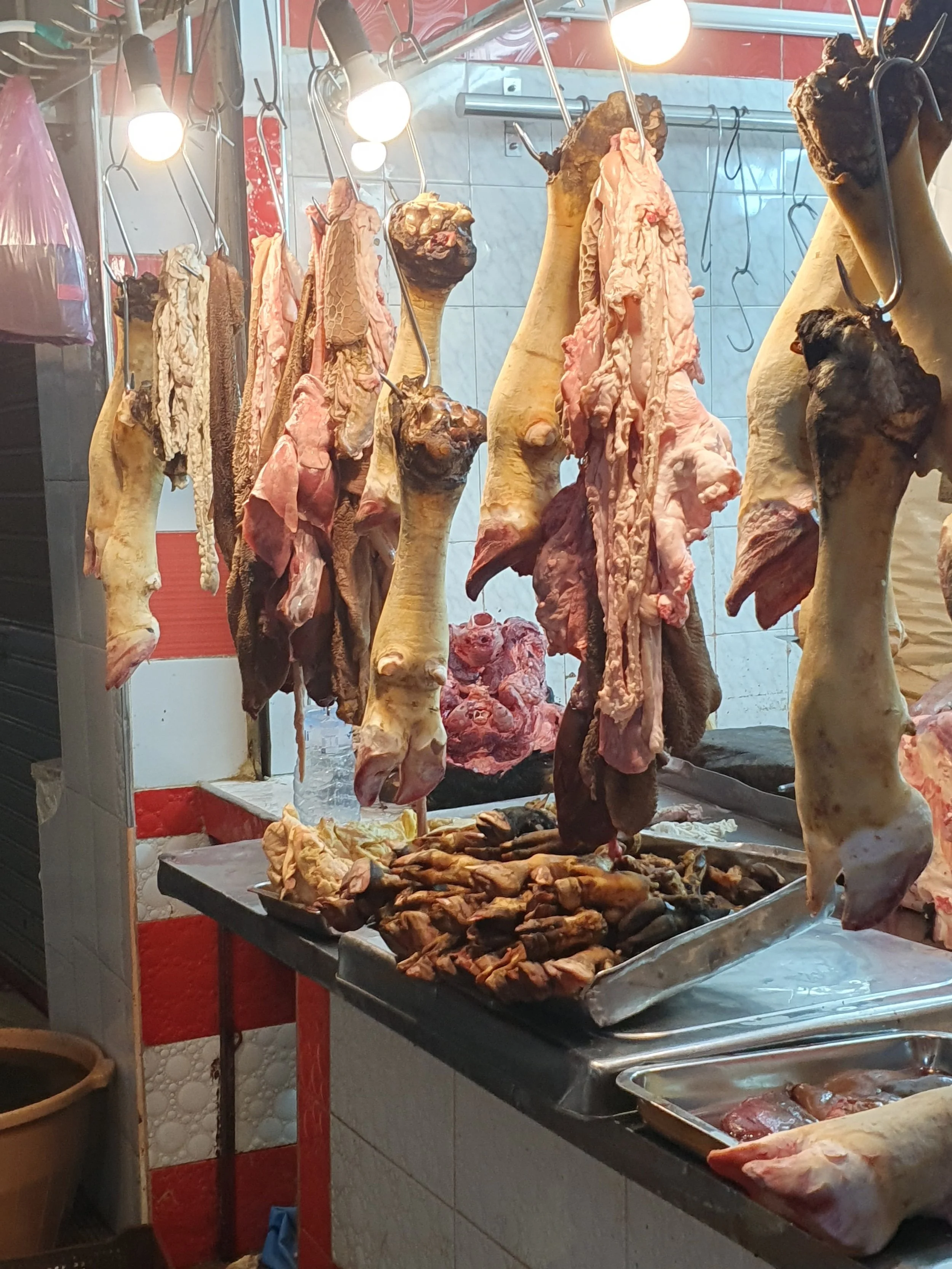
A butcher, with absolutely everything available - no waste.
Can you also find the very, very local eatery tucked around the corner behind all this? Don’t be deceived by their looks – their food is good. Get yourself a very Moroccan adenture!
Out on the square again, behind the mosque on the other side of the fountain, (and many other spots) there are the other kind of markets that the locals use, not the tourists. You can find tagine pots and second-hand goods, and feel the atmosphere of Tangier.
8 Gran Café du Paris and the Canons over Spain
If you go on up from the fountain square past Cinema Rif you will reach another fountain. This is Place du France. On the right-hand corner is the French embassy, but on your left is Gran Café du Paris, another haunt for local characters and a great place for coffee or tea, and to watch the world go by. It reminds me of the atmosphere of the movie Casablanca. But the Bourne Ultimatum (the third of these Matt Damon movies) had several scenes set in and around here.
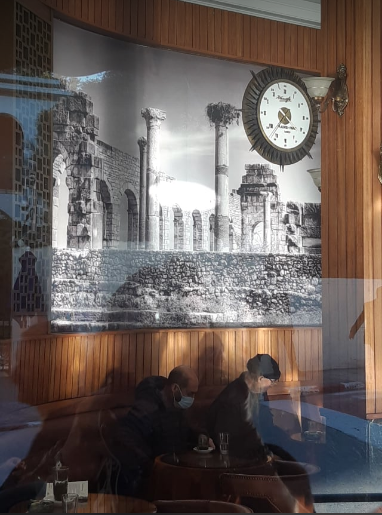
Inside Gran Cafe du Paris - somehow a sense of timelessness, and evoking the movie Casablanca.
If you follow it around the corner, you come to the canons, Sur Ma’agasin. A plaque has been put there by the government explaining it as a place to relax, but that’s not quite right. The real meaning of Sur Ma’agasin is “The Lazy Wall”! It is one of my favourite spots in Tangier because I love the view of Spain from here. You might not be as excited by all this as me, but I’m from Australia, where everywhere you can see or go is somewhere else in Australia!

View from the cannons next to Gran Cafe du Paris.
9 Go Swimming
Not to overlook Tangier’s locations, you can always go swimming in the bay. The further up you walk the nicer the beaches, but it is quite reasonable to swim in Tangier Bay, even in summer – just 10 minutes’ walk from the bottom of the medina. The winter gets a bit chilly from the Atlantic current sweeping in, but some years I have swum as late as in October. If you come from Alaska or Moscow, I’m sure even later would be no issue.
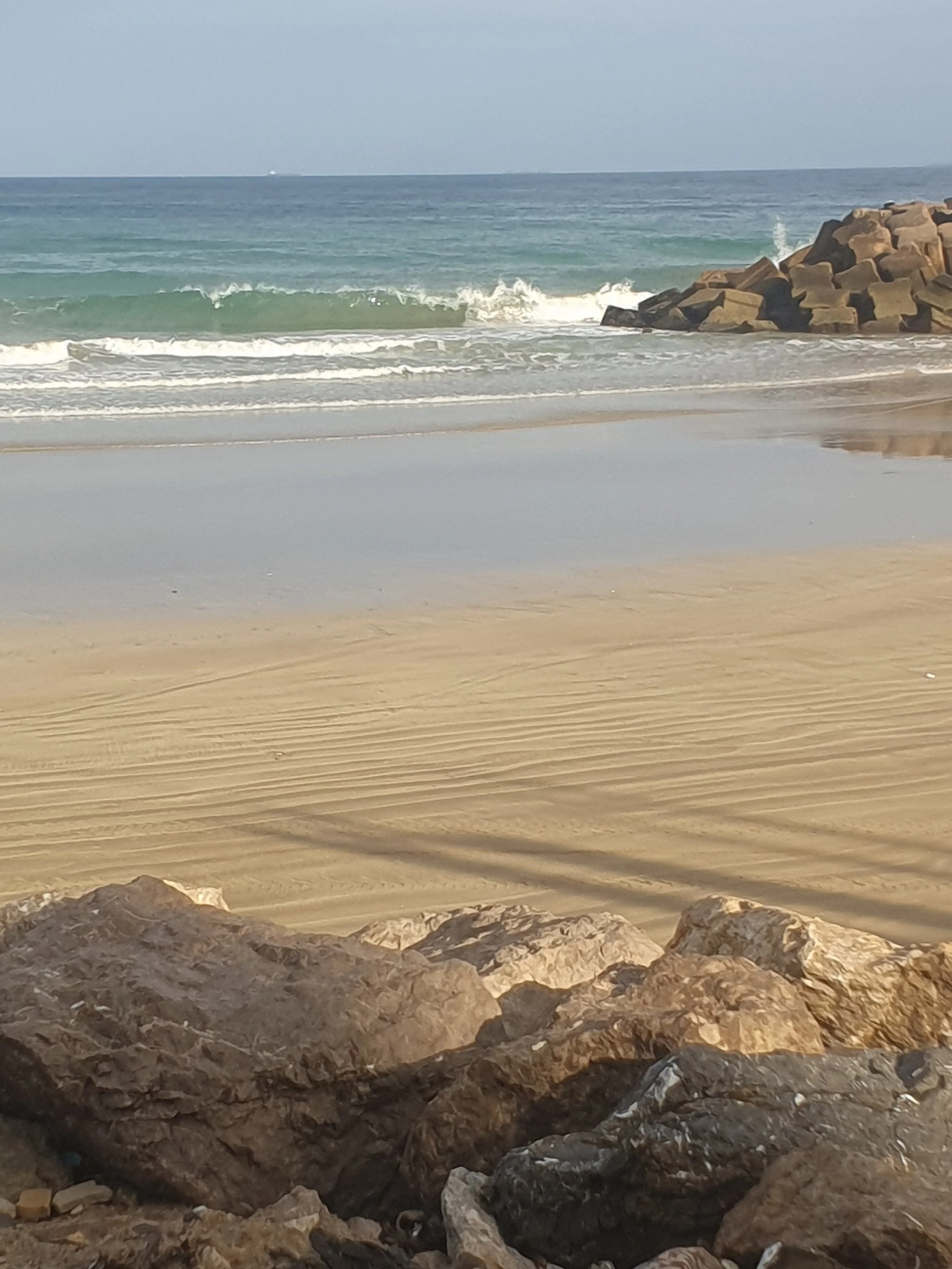
Tangier Bay at the far end near Malabata.
10 Sunset at Chiringuito
Tangier has so many classic sunset spots, just one of which is Café Hafa. But if you’re wanting something a little classier, there is a restaurant-bar in the Marina which has lovely views across the boats and a sun setting over the medina. This is Chiringuito. The food here is also good. It is out along the walkway from the start of the beach. There are several cafes and restaurants, and even Club 555 right down at the end. But go to Chiringuito.
Sit yourself at one of the tables with a view out through the floor to ceiling windows and sip a wine, a beer, or a cocktail, and maybe some of their food, to a view of the sun setting over the medina and its tumble of white buildings.
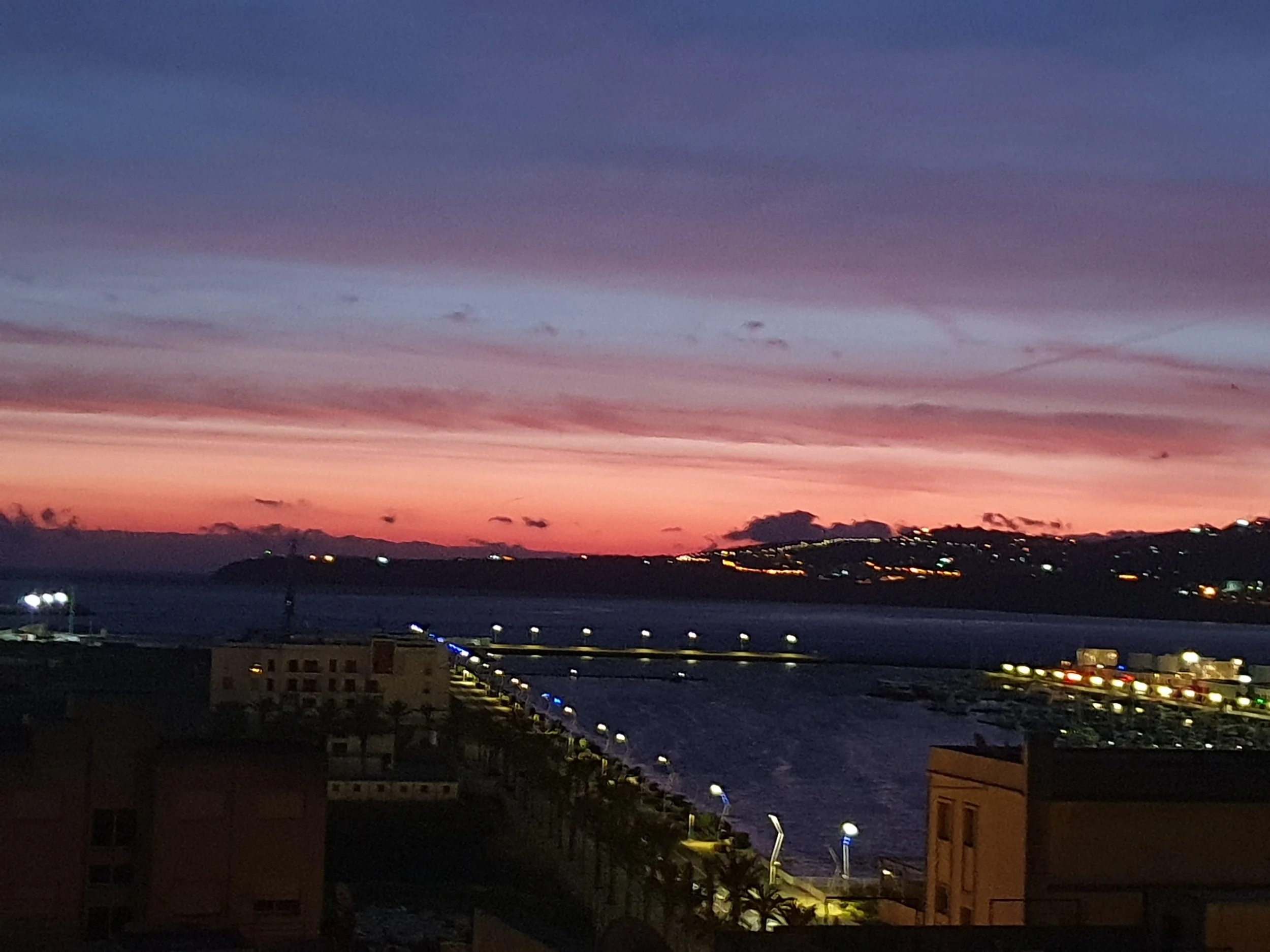
Chiringuito is in the row of bright lights on the right, looking this way across the medina.
Managing Ramadan in Tangier in 2026
Managing Ramadan in Tangier 2026
If you arrive in Tangier in the middle of Ramadan - Where can you eat? How can you participate?
Ramadan Kareem
So you’ve arrived in Tangier in the middle of Ramadan. How do you manage?
It is not the best time to visit, since everything is go-slow, shorter hours, and eating during the day isn’t easy. But sometimes in spite of the best laid plans you may find yourself in Morocco during Ramadan. And of course, there are those who live in Tangier.
Restaurants and cafés are closed during daylight hours, night clubs and bars are closed for the whole month, and you have shorter hours and a sluggish population? I have so often found hungry tourists wandering around unable to find a place to eat. It’s like Christmas – a special time for the family, but with everything closed it’s not much fun for the tourist.
So here’s a guide on Ramadan in Tangier, how to negotiate the challenges and how to make the most of this time. And maybe most important of all, where to find somewhere open to eat.
What is Ramadan?
Ramadan is a month in the Islamic calendar of reflection and abstinence in the spirit of appreciating the less fortunate. In aid of this, it is a month of fasting during daylight hours including no water, and abstaining from alcohol, smoking and sex. Everyone is up early to eat before daylight. Business hours are shortened and Morocco has its one month of the year which is not on summer time hours.
When is Ramadan 2026?
Ramadan is moon based like Easter, so each year is a different date. While Easter is fixed to a date between February and April, Ramadan moves forwards by around 2 weeks every year. In 2026 it is scheduled to start from around the 18th February, and will last for a lunar month, until around the 19th March.
Why do I say an approximate date? Because the day is decided according to the crescent moon by the top Iman in each country. Apparently all our technological advancements aren’t adequate.
The precise measure of the day of the crescent moon, and the start and end of Ramadan is decided only on the day. Morocco usually starts and finishes a day different to the rest of the Islamic world, something maybe understood only by Allah himself.

What happens in Ramadan in Tangier?
Each country expresses Islam and responds to Ramadan differently. On the whole Morocco is relaxed about Islam – except for Ramadan. Their population is officially stated to be 99% Muslim – although going by the number of people (especially young people) who don’t pay it much attention and who don’t wish to fast during Ramadan, the real number may be quite different. Nevertheless, it is officially illegal for an adult Moroccan to eat in public during daylight hours and they can be arrested, unless exempt – such as for health reasons, if travelling, or if a woman is pregnant or menstruating. Children start fasting from puberty, so roughly around the age of 12 to 15, with children starting to practice from the age of 5. The social pressure to fast is very strong.
In Tangier all bars are closed for the month, and for the few days at the end, which is the Eid celebration of the end of Ramadan. Almost all restaurants are closed in the day time. The streets are quiet for most of the day. For the two hours before sunset, the streets go crazy with everyone rushing to do their food shopping before f’tour.

Rue d’Italie 15 minutes before F’tour
Then, in the space of 15 minutes, even the busiest streets go from absolute chaos to empty. It’s both eerie and kind of magical at the same time.

Rue d’Italie - at f’tour and just 15 minutes after the above photo, same day, same spot. The blue 3 wheel truck hasn’t moved.
Be aware that there will be almost no taxis from this time for a couple of hours. Nothing happens. A population of hungry people is breaking their fast.
Options in Tangier – How to Manage as a Tourist

Petit Socco - ‘small square’ - in the middle of the medina (old city)
During the day time, the best place to find cafes and restaurants is in the medina (the old walled city). Gran Café Central in the Petit Socco is always open. But be warned – as one of the few options, it is typically very crowded for this period. Right next to it is Café Tingis. Besides drinks, they will offer a tagine at this time. They also will not refuse to serve Arabic people which is common in most other places open. There is another little café on the other side of Café Central facing down the street which is also open and also serves everybody.

Cafe Tingis in Petit Socco which serves everyone, including Moroccans. The awning of Gran Cafe Central is on the right.
Big hotels will also usually have their restaurants open for tourists – along the Corniche (road that fronts the sea), and places like Hotel Rembrandt, El Minzah, and the Hilton are likely candidates.
There are a few other places usually open every Ramadan:
Abou Tayssir – or The Syrian. This is a good one all year round and one of my favourites. In Rue d’Italie, the steep street next to the medina and opposite Cine Alcazar.

Abo Tayssir, The Syrian and my first recommendation year round, and open during Ramadan in the day time. They have now expanded into the shop next door on the right (shuttered in the photo). Cafe Colon is to its left, with Cine Alcazar opposite.
Comedia (especially the one in the arcade over the water, and the ones next to it) and Downtown cafes on the Boulevard – past Hotel Rembrandt (their restaurant may also be open) on the way to the post office. It changes each year, but these ones are generally open every year serving food.
Anji Chinese Restaurant – on the Corniche opposite Marina Hotel should be open. An excellent restaurant and a favourite one of mine all year round. There is also a Chinese restaurant on the beach in Malabata run by the same people.
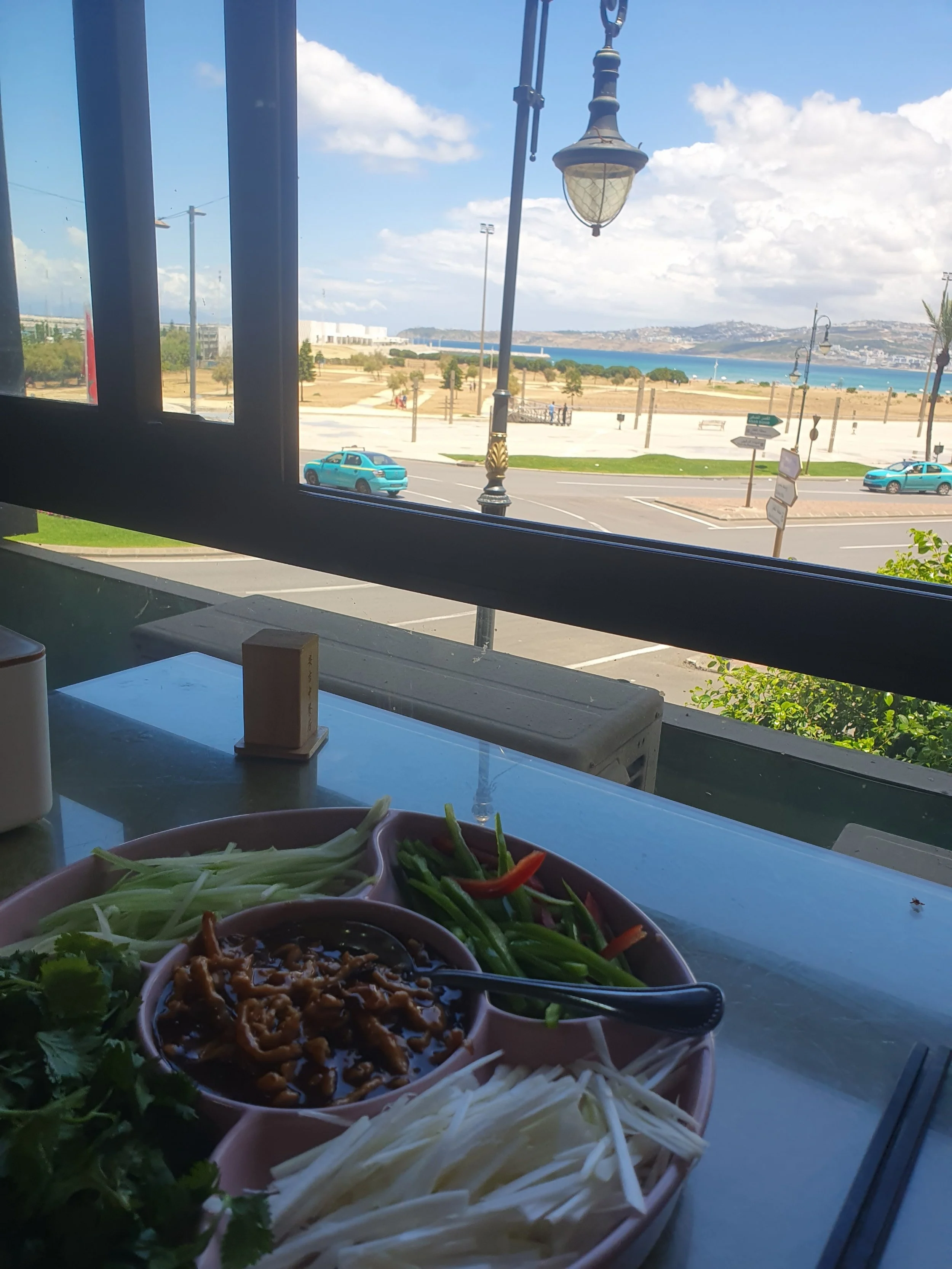
Anji Chinese restaurant on the Corniche - another year round favourite of mine. It also serves beer.
La Cocina – is on the Corniche near the ferry terminal, and usually open and serving food and alcohol.
Ba sidi – On Rue d’Italie, and likely to be open.
MacDonalds – Guaranteed to be open. There is one near Hotel Rembrandt, and another on the Corniche near the train station. There is also a KFC next to this second one.
Villa Mokhtar – Rather nice with rooftop views for cocktails, off Rue d’Italie on the small street just before the one to Bab Kasbah (the Kasbah gate) at the top of the hill.
There will also be several places in the medina which are likely to be open, such as The Morocco Club.
Mesana isn’t open in day time hours, but it serves alcohol in the evenings through Ramadan. It’s a Spanish Basque restaurant on the Corniche just past train station.
Buying Alcohol
Many cities in Morocco are completely dry during Ramadan, with zero alcohol options. However, Tangier usually does have a couple. The standard one where you can stock up on alcohol during the day hours is Casa Pepe, between MacDonalds and Hotel Rembrandt. Note that it is sharp with its closing time and may even close early so the owners can get home in time for f’tour. (Socco Alto supermarket bottle shop is never open.)

Between MacDonalds and Hotel Rembrandt on the Boulevard, these guys sell alcohol in the day, also a delicatessen. Make sure you take your passport, even if you are blonde, blue eyed, and don’t speak a word of Arabic.
Be aware that in Morocco you need to keep any bottles discrete and hidden in public at all times, even when they are empty. During Ramadan this may even turn to hostility. If you have an Arabic name or look, you will not be served. Even if you don’t you will need to produce your passport in confirmation of this – even if you are blonde and blue-eyed. At these times it’s handy to have a friend with a non-Arabic passport.
Note that for Eid, even these outlets will be closed. For these few days the whole of Morocco is dry. If you want access, stock up beforehand.
What is F’tour?
F’tour or Iftar is breakfast, and means exactly the same as the English – breaking a fast. If you get invited for breakfast, it will be for sunset. But here are some ways that can make Ramadan more fun, and to have a taste of the experience.
Café - F’tour
Many cafes have a f’tour menu, and open for it in time for sunset. The fancier cafes will have a fancier menu, but my suggestion would be to go to one of the cheap local cafes where the Moroccans go. I have been to one down on the Corniche near to the ferry terminal, between the Terminus wine bar and the small roundabout near it down from the fish markets. It is one of several which is ready to go at sunset.
The tables will be set out with 3 dates, an egg, and l’ben to drink (a sour yoghurt drink, or buttermilk). You can sit and wait with the others there for the prayer call, and break your fast with them. The meal will then follow – you order yours beforehand so it is ready for you.
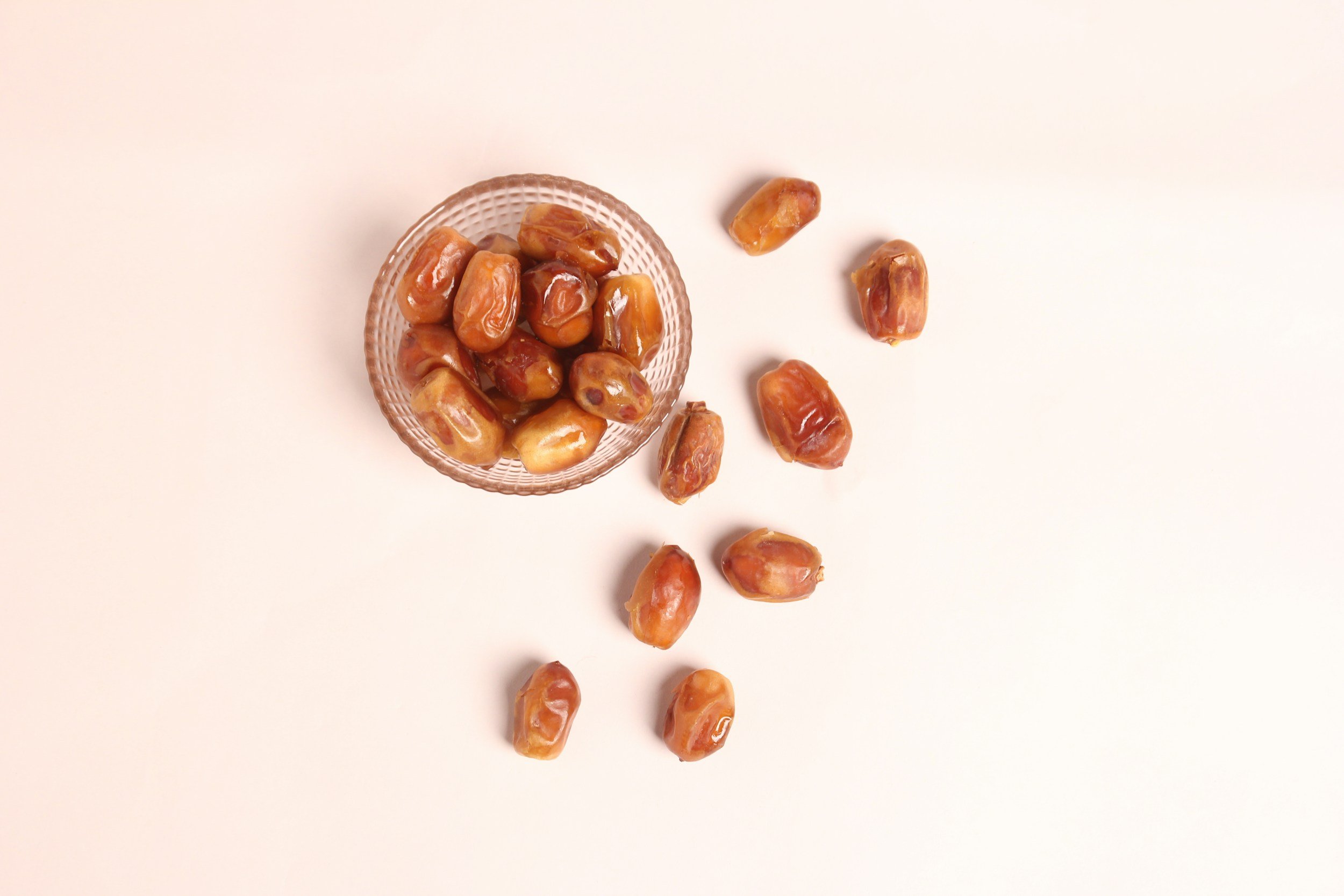
The fast is broken with a sour yoghurt drink (L’ben) after nothing to drink all day - a drink with energy, dates - a quick sweet fix to get the blood sugar going again, and a boiled egg. Then the meal.
Picnic - F’tour
Another option is to buy your foods or takeaways before sunset and take them with you to one of the parks or the beach. Wait until the prayer call and then enjoy the picnic.
Non-food Cafes - F’tour
When not cooking at home I take food or buy takeaways to a favourite café. I often arrange a gathering of friends. Ask at the café – it will be closed through the day, but they usually set up in the late afternoon so that they are ready to open after f’tour/iftar. They are likely to be happy to let you sit at the tables to eat as long as you then buy a drink when they finish their f’tour.
My favourite spot for this is Café Colon on Rue d’Italie, opposite Cine Alcazar where I could watch the street empty out before sunset, enjoy eating, and then chill over a mint tea or coffee afterwards, and into the evening. Sometimes we arranged for food from Abou Tayssier next door, the brilliant Syrian restaurant. After this we just sit and chat, or sometimes go to practice playing pool.
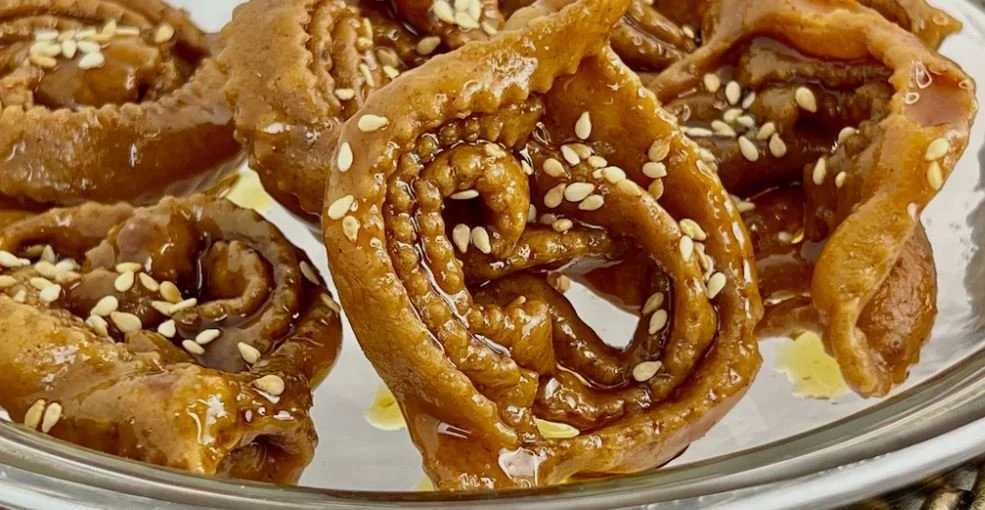
Chebakia - Ramadan sweet in Morocco, knotted pastries doused in syrup. You can also try Bsaha, a very densely packed variety of ground nuts which is eaten with a spoon.
Surviving the Days
It may be worth carrying some snacks with you, especially if you leave the medina. Fruit shops and supermarkets will be open through the day – stock up when you see one, and maybe keep a supply of nuts on you. And be more on the watch out than usual. After 2pm with dropped blood sugar levels and withdrawal from cigarettes hitting hard, judgement is off and patience is short. People get cranky, arguments are common, and traffic becomes far less aware than the usual standards, which are surprisingly high (the rest of the year). Accidents are more frequent - don’t be part of one.
Join the Fast
And of course, you can choose to join in with the fasting. If you do this, don’t presume for a normal day, but take it easy. Moroccans have a meal before daylight, and spend a lot of the day sleeping. Everything will be open in the evenings. After the streets go quiet for a couple of hours, they then fill up with festive Moroccans who are re-energised and out with their friends, especially after the first days of Ramadan which are more likely to be spent with family.
Have you found something worth a day time trip? Or had a Ramadan experience to share?
Ramadan Kareem - if you do find yourself in Morocco during Ramadan, make the most of it and enjoy your time..
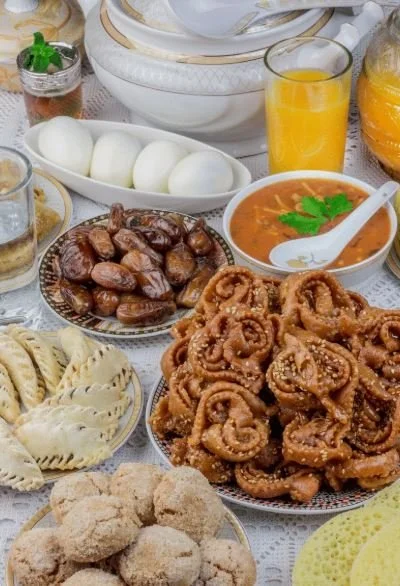
F’tour or iftar - dates, eggs and juice or l’ben, plus chebakia and other Moroccan nut biscuits.
Finding Toilets in Morocco
20 Need-to-know tips for arriving in Morocco - Tangier and other survival tips - Survival Arrival Tips!
When You’ve Gotta Go…!!!
20 Things you Need-to-Know
Tips For Morocco - Tangier
Here are 20 Must-Know tips about Morocco (Tangier-specific) before you go – so to speak. 😉 Many people pass through Tangier (Walk With Me) and post their lists, but their information is superficial and often not very accurate, being based on generalisations about other countries. Morocco (Where’s where and where to visit) has a unique culture, and often differs in how things work compared to elsewhere.
Having lived in Tangier for 4 years, here are the real details of how to negotiate your way through Tangier and the Moroccan culture – the do’s and don’ts of Morocco, and other useful information.
Orientation in Tangier
New cities are often confusing, so let’s sort out Tangier. These major landmarks give you an orientation and points of reference, including a location to give to taxi drivers.
Medina – just means city centre, but often refers specifically to the old medina, the old walled city, typically with narrow winding alleyways of blank walls, all designed to confuse the enemy – and successfully confuses tourists and visitors even today. The locals know this, and often want to be helpful. If they lead you somewhere, a few dirhams is a nice gesture. Don’t stress about getting lost - enjoy the experience. Your GPS will usually sort you when you’ve had enough. Motorised vehicles (besides motorbikes) are banned. (Fes is the largest non-motorised city centre in the world, and has the largest medina.)

A night view - an endless maze of intriguing shapes, alleyways and photo opportunities. If you were ever curious about how cities were shaped several centuries ago, medinas still tell that story.
Kasbah – Means fortified castle, and in Tangier is at the top of the medina (I Sat on Henri Matisse’s Knee - a tour). A taxi to the Kasbah will get you to the top of the medina and the Kashbah gate.
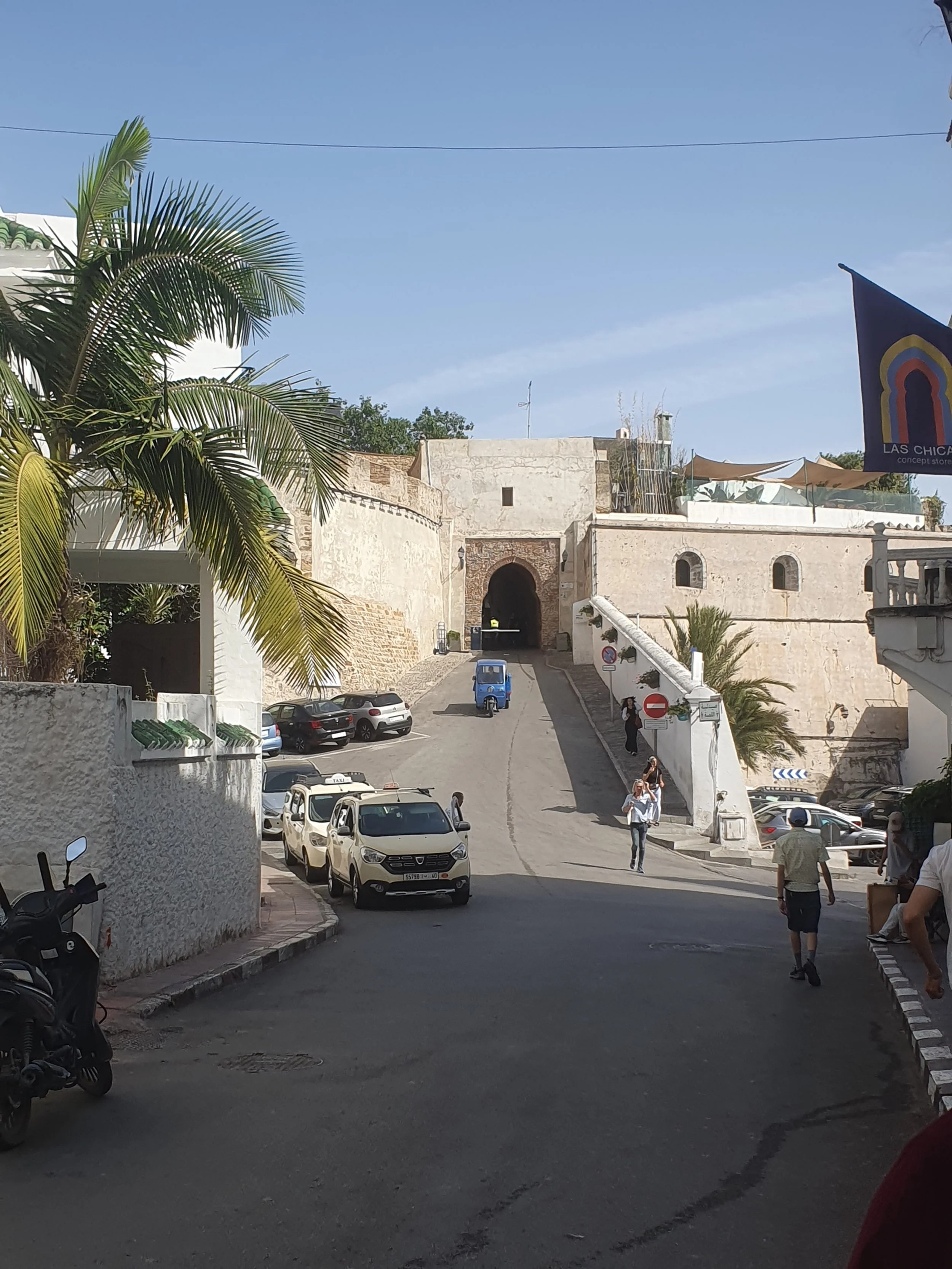
A view of Bab Kasbah - the Kasbah Gate - leading into the medina at the top. The steep street down to Grand Socco is on the right.
Petit Socco – Literally ‘small market or square’, the name of the square in the middle of the old medina where you find Grand Café Centrale and Café Tingis and Cafe Fuentes (Tangier’s Toulouse-Lautrec ).
Grand Socco – ‘Big square’. Walk uphill from Petit Socco to the open area with the fountain, and mosque, and Cinema Rif (Foreign Movies Filmed in Morocco) – a good location name to use for taxis.

Grand Socco: With the edge of the fountain on the left, the white arched gate leads to the steep street which runs along the outside medina wall up to the Kasbah. The gap between the buildings is your main street into the medina, directly to Petit Socco. Just right of the photo is another gate into a building - this is Souq Barra, your markets. Follow it to the right and you go past the olives, fruit and vegetables, chicken, meat, and finally the fish markets.
Gran Café de Paris – Keep walking uphill on the left side of Cinema Rif and you will find this Art Deco classic café that always reminds me of the movie Casablanca at the next fountain – also a good location name for taxis, and a nice spot for a tea or coffee (Secrets Behind the Movie Camera).
The Boulevard – The big street where Gran Café de Paris is.

Boulevard at night, right next door to Cafe de Paris and Le Coeur de Tanger (Night Life in Tangier) - a part of Tangier that never sleeps. This is about 9pm - on a Sunday, looking over the canons (It’s like this still at 2am an later). There’s a great view of Spain from the canons most days. This space is called Sur Magasin - or the Lazy Wall…
The Corniche – The even bigger street that runs along the waterfront.
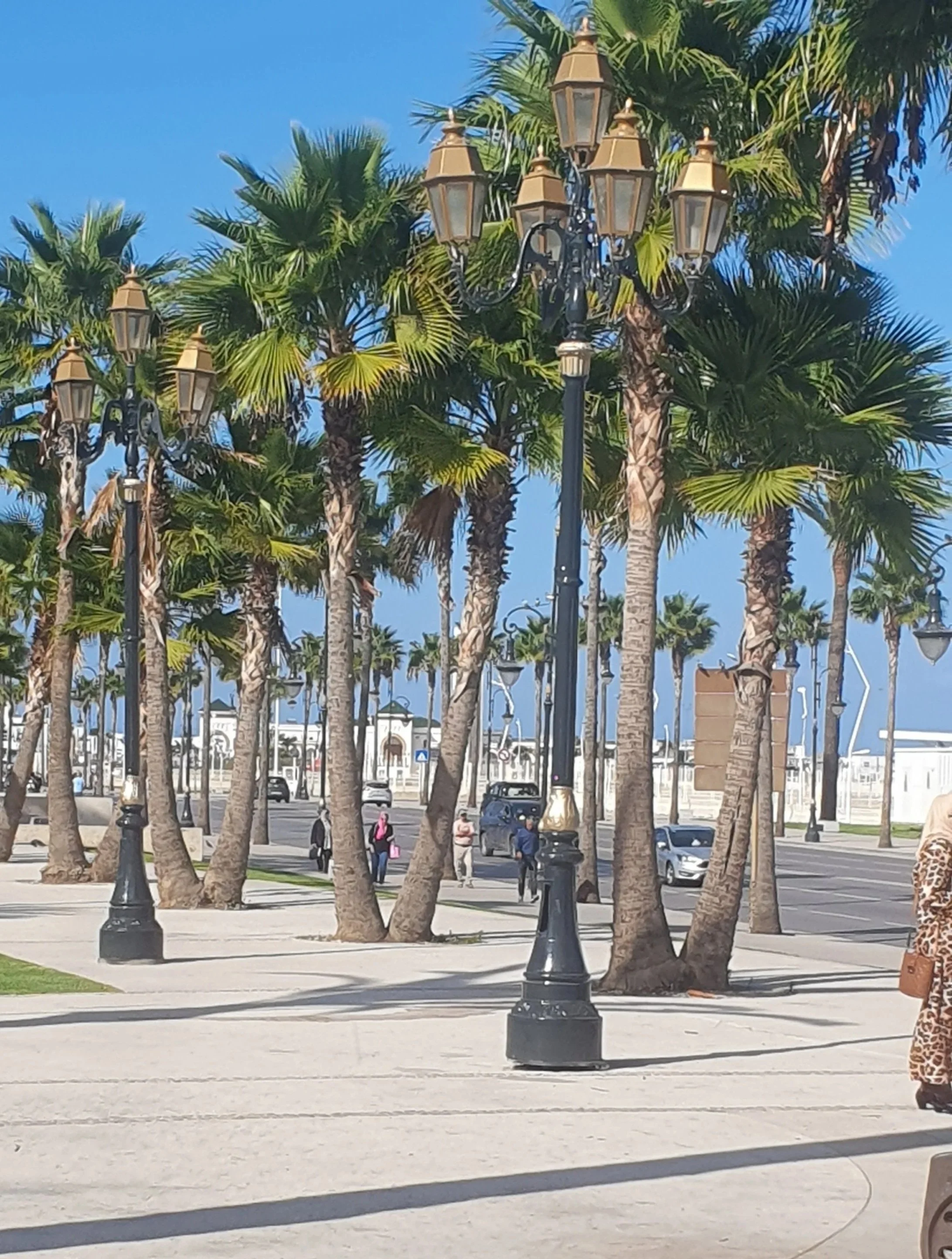
The Corniche near the base of the medina, Hotel Continental and the ferry terminal.

Looking over the Corniche, its broad walkway, and the Marina beach and bay across to Tangier’s casino. The white buildings on the left include Churinguito, a nice spot for an elegant drink to a medina sunset - and decent food.
1 When You Need a Toilet
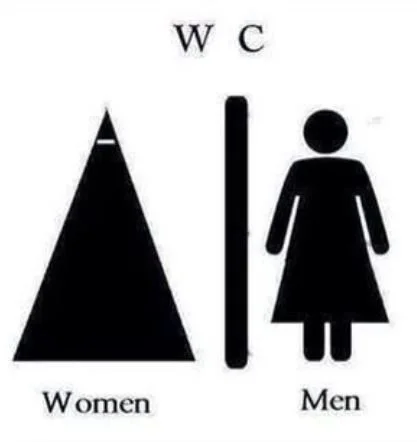
Cafes will have toilets (nicer cafes will have nicer toilets), but these can be daunting for the fledgling visitor, especially if the need becomes urgent in a public place – they often require a bit of a trek. They may require a key, they may be squat style, and probably have water and a bucket for rinsing, but no paper. When it’s urgent, they all do the job. But if you have space for planning here are two nice ones – with paper.
Cinema Rif – Cinema and café, this is a great landmark that everyone knows, and a nice spot to stop for a tea or coffee and sit on your way past in Grand Socco.

Bathroom at Cinema Rif - This is one of my trick visits with newbies in town. What is wrong with this picture….?
Hotel El Minzah – Between Grand Socco and Café de Paris, on your left you will pass the small entrance to this fancy hotel, where many film stars and other famous people have stayed. Walk in with confidence, down the steps and around to your right. In the courtyard there, you will find very nice toilets.


Not to freak you out, but these are the kind of toilets you might encounter, that are the norm in many parts of the world. Most cafes have western style toilets, but you may encounter one of these - forewarned is fore-prepared. The biggest factor is that Moroccans clean with water, which splashes everywhere (my friend’s phrase for this is ‘mooshy gooshy’) and there is nowhere to hang your bag. At least they smell better than many public toilets I’ve been to.
2 Tissues
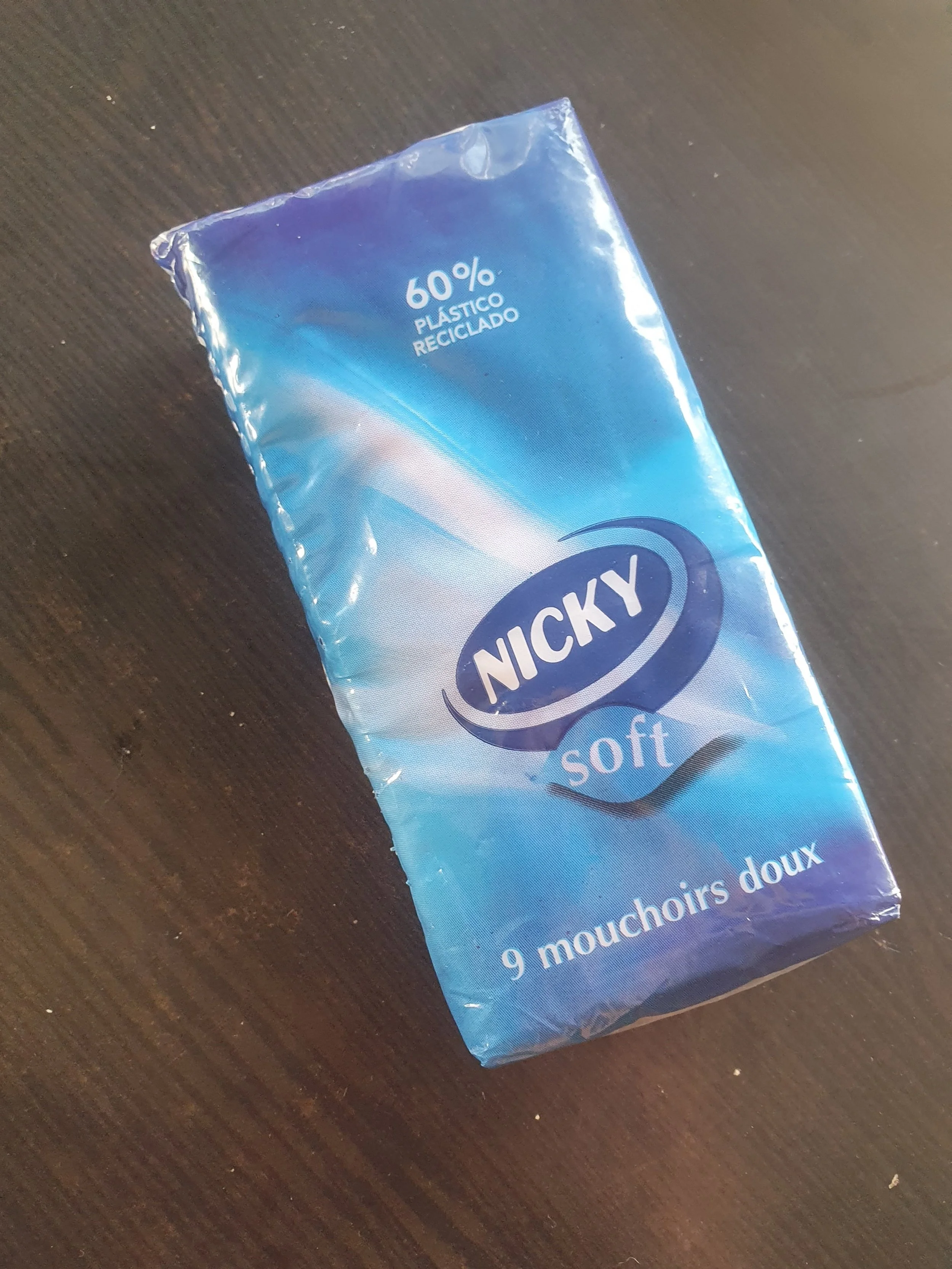
You will very quickly discover there is no toilet paper in most toilets. You will need your own supply. There is a regular supply of people roaming the streets or sitting in their spot on the footpath selling small packets of tissues. The usual price is 2 dirhams – I usually buy 2 packets and give them 5 dirhams. Clearly these guys don’t make much, and I like to support them.
I never buy from the children. Much as I feel sorry for them, they pester unpleasantly, and buying from them will make no difference to their lives. At the end of the day they will still get badly treated by the people that control them.
You can also buy packets in little shops, but I prefer to support the ones who are trying to get a little extra.
Another thing worth being aware of is a complete lack of anywhere to put anything - your phone, wallet, or bag. Pockets and shoulder bags are handy. My main trick is to put my phone and purse into my skirt and hold it up into a pocket with my mouth. This can be a little tricky. The last thing you want is to drop your phone onto a wet floor, or into the toilet! The guys may have even more trouble with this technique, being less likely to wear a skirt (unless you go native and wear the local djelaba) - but then, pockets are more common in men’s clothing. But pay attention to phones dropping out of pants pockets when loose!
It is easy to plan for this, though - have a shoulder bag or a bum bag so you’ve got somewhere to put everything and are hands-free. But when you’ve gotta go, you’ve gotta go, and in the end, they all do the job.
3 Toilet Etiquette
Be mindful that most toilets in Morocco don’t have sewerage systems to adequately dispose of paper. The pipes are too narrow, and even toilet paper will clog up the system and cause the toilets to be blocked and unusable. Throw your used toilet paper into the bin provided. Before you dismiss this as backward, keep in mind that the Islamic way is to wash with water and the left hand (hence a preference for the right hand when eating). To them – a very clean culture – using only toilet paper is not very clean.
4 Dress Code
Morocco is a Muslim country. It is respectful to cover your shoulders, cleavage and knees. In the touristy areas such as Tangier medina, the locals are pretty relaxed and you can get away with almost anything, but you won’t be respected and may earn extra catcalls. There is no need for head scarves or any other coverings. I usually wear a long scarf which I pull over my shoulders.

I wear dresses below my knees, and I always wear a scarf which I pull over my shoulders when I’m out. My mini skirts I save for winter when I can wear black leggings to cover my knees. The hats are just my thing. But any variations that cover knees and shoulders are fine, including jeans and pants.
5 Personal Safety
You may get hassled – this happens in many countries. But Morocco is one of the safest countries I have been in. Don’t let media hype and western normalities override, and keep in mind that a bit of hassling is not the same as being in danger.
In most western countries, if a man is asking your name and where you are from you are already in trouble. In Morocco, especially Tangier, he is literally being friendly and curious, and probably hopeful that you will be interested in his carpets. Simply ignoring someone is fine. I usually just say hello with a smile and keep on walking: Salam.
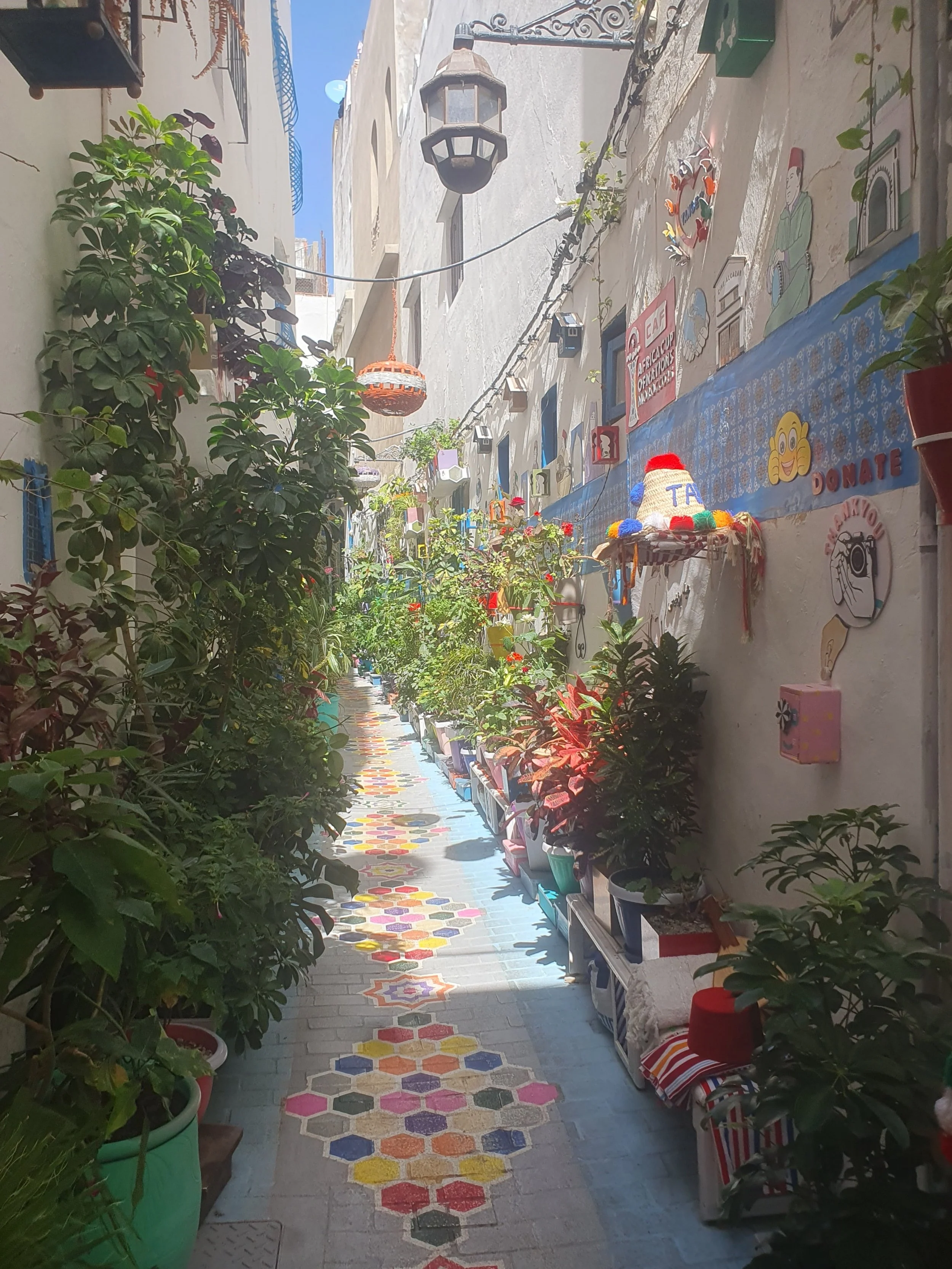
Some streets in the medina you might stumble across.
The narrow medina streets in Tangier are safe. I have walked alone all over Tangier at all hours of the day and night, and my space has never been compromised in the medina. Media gaslighting and safety rules from my western culture had me very nervous my first two nights in the Tangier medina. The streets were narrow and dark, and guys were hanging around.
But then I noticed that they literally were just hanging around - because it was nicer outside than inside, easier to meet friends, and nobody was interested. I realised that the medina streets are safe, and over time that even late at night in the streets outside the medina, it is safer than many places I’ve been.
If for any reason someone intrudes uncomfortably on your space, simply react loudly. People will come – they are everywhere. Most Moroccans are extremely offended by such behaviour. You are much safer in Morocco than you probably are in your home country. You are just used to the familiar conditions of home. Asking you for a tea in a rug shop will be just that.
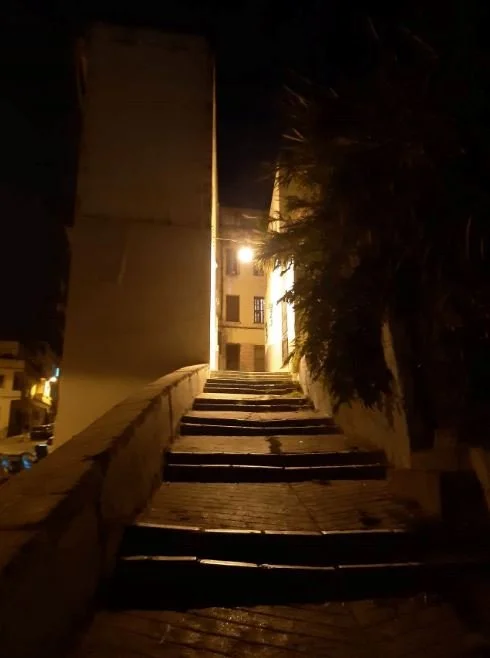
Not dangerous, but an intriguing alleyway at night, and good for different light effects and photos without people in the way. This one lead up to my flat - residential and quiet, and never a problem at any hour. Footsteps coming up behind you are just someone in more of a hurry to get somewhere than you are.
6 Theft
While not very common, it can happen occasionally. But I normally walk around with my strap bag hanging over my shoulder, and have never had a problem. When in crowded places, it isn’t smart to have your purse or phone at the top of an open bag anywhere in the world. This is a far worse problem in Europe, such as places like Barcelona and Italy. I have never had a problem in Morocco – although I would be careful in Marrakech’s Jemaa el Fna Square. But the most likely scenario if you leave your phone or purse somewhere is that you will be chased for its return.

A glimpse of lovely tile-work when passing an open door into an apartment building.
7 Cash is King
Morocco is one of the highest cash-usage countries in the world. Most places don’t take cards (outside big hotels and fancy restaurants), so you will need cash. It is also a closed currency, which means you are not allowed to leave Morocco with dirhams. You will find it very hard if not impossible to find dirhams before you arrive, or to sell them after you leave.
There are lots of ATMs everywhere, especially in touristy areas. They usually have a fee of 35 dhs (€3.50). Make sure of the exchange rate first, by looking up your desired cash amount (eg 2,000 mad ) on a google search. Moroccan dirhams are MAD (Maghrebi dirhams), not to be mistaken for dirhams in other countries (much to my disappointment following a job offer).
I find a much better rate from my euros account. From AUD there is a built in $20-30 AUD in the exchange rate, with my bank charging another $20 AUD of fees from my account. You can usually see the exchange before you complete the transaction, but not always.

Farm ladies from the Rif selling herbs and vegetables fresher than any shop at home.
Withdraw larger amounts less often to minimise this cost, but your dirhams will give you good milage. 2000dhs will go a long way unless you make a big purchase, like a rug. Also don’t “accept the conversion” - say no. The conversion usually has extra fees. Typically meals are just €7. I’ve found the Banque de Afrique has good rates, near the exchange. Let me know which ones you had the best rates.
Alternatively, you can bring cash with you to exchange at the bureaus which have good exchange rates. They are also everywhere in the tourist areas. Main currencies are accepted – definitely Euros, USD and English pounds, so no need to change before you arrive.
Airport exchange is expensive, but the taxis from the airport (€15 or €20 in Tangier depending on your destination) will accept euros – probably also USD and pounds. If you arrive by ferry, there are ATMs at the port on your way out of the building.

Dates - the pick is the mezjool dates. This is a treat you should not skip!
Make sure you change your money at an exchange bureau before flying out of Morocco – the airport exchange rates are not good, and the chances of selling your dirhams once you leave will be extremely small. They may ask for proof of changing the money in the first place, so keep a couple of receipts.
Another oddity about Morocco is that you will be constantly chasing the small coins. Almost everywhere else I’ve been, the coins become a heavy problem and I find myself pushing to get rid of them. In Morocco, if you only have big notes - even 50dhs, it is more likely that you will have to wait while the vendor gets change from a neighbour. Being caught with a 100dhs note for a short taxi ride, for example, or wanting to buy some fruit or a small souvenir for just a few dirhams.
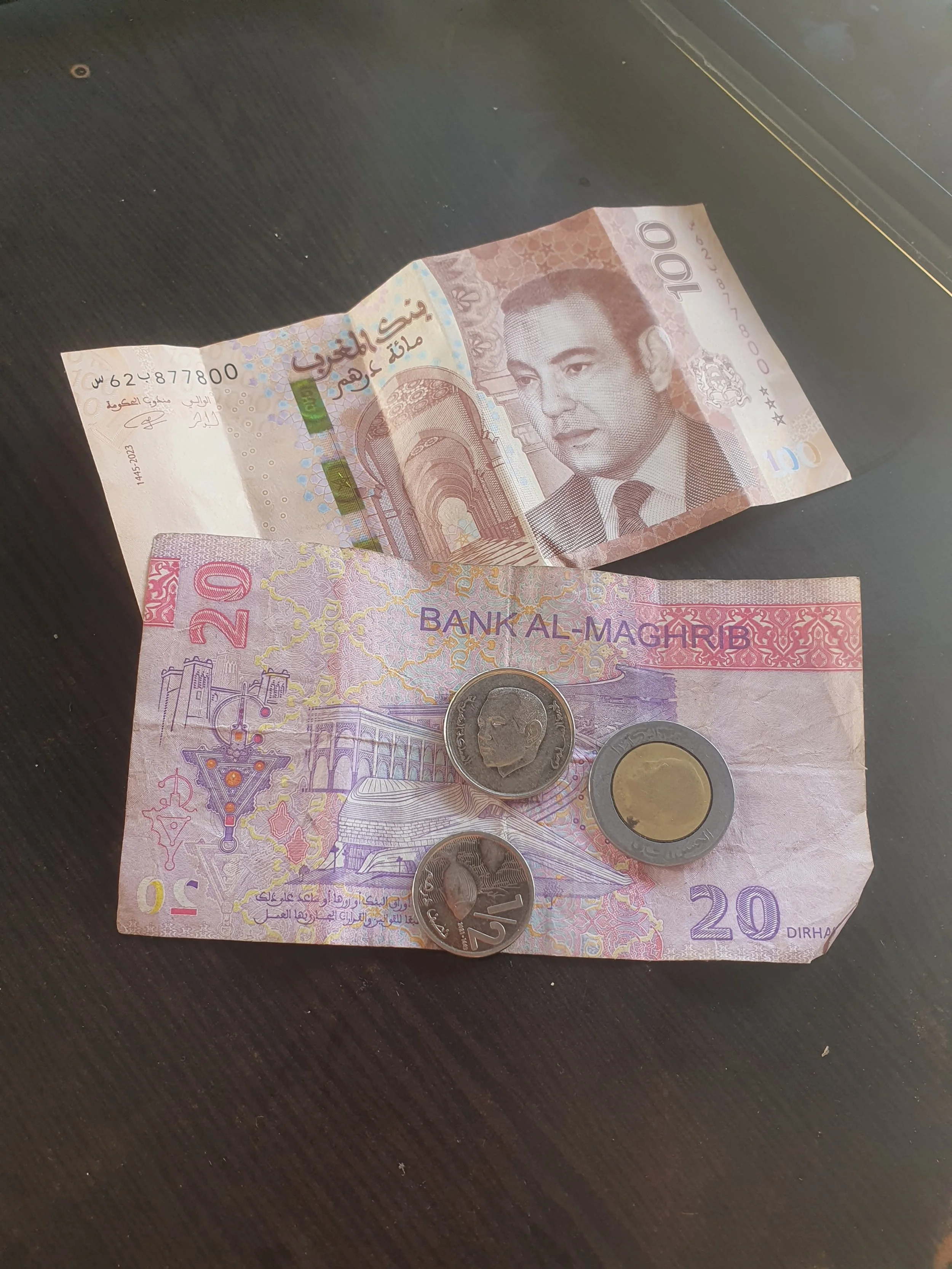
There is also a green 50dhs note, and watch out for the 2 dhs coin, almost the same as the 1dhs coin. The 10dhs coin has a gold rim, the opposite of the 5dhs pictured with the silver on the rim.
Notes: 200 dhs - blue, 100 dhs - orange, 50 dhs - green, 20dhs - purple
Coins: 10 dhs - gold rim, silver centre, 5 dhs - silver rim, gold centre, 2 dhs silver with angled inside edge, 1 dhs - silver, ½ or nos - silver.
8 Tipping
Morocco is not customarily a tipping country – most Moroccans don’t tip. But their wages are very low, so I routinely tip 10% at all cafes and restaurants, as do most foreigners I know - but not all.
You pay the waiter who serves you. If their shift is ending, you will need to pay them before they leave even if you haven’t finished.
Don’t expect the level of service you may be used to – the service will be sometimes very slow (except in Marrakech where I found the service above exceptional!) Treat this as part of the culture. If you want the same service as at home, stay at home.
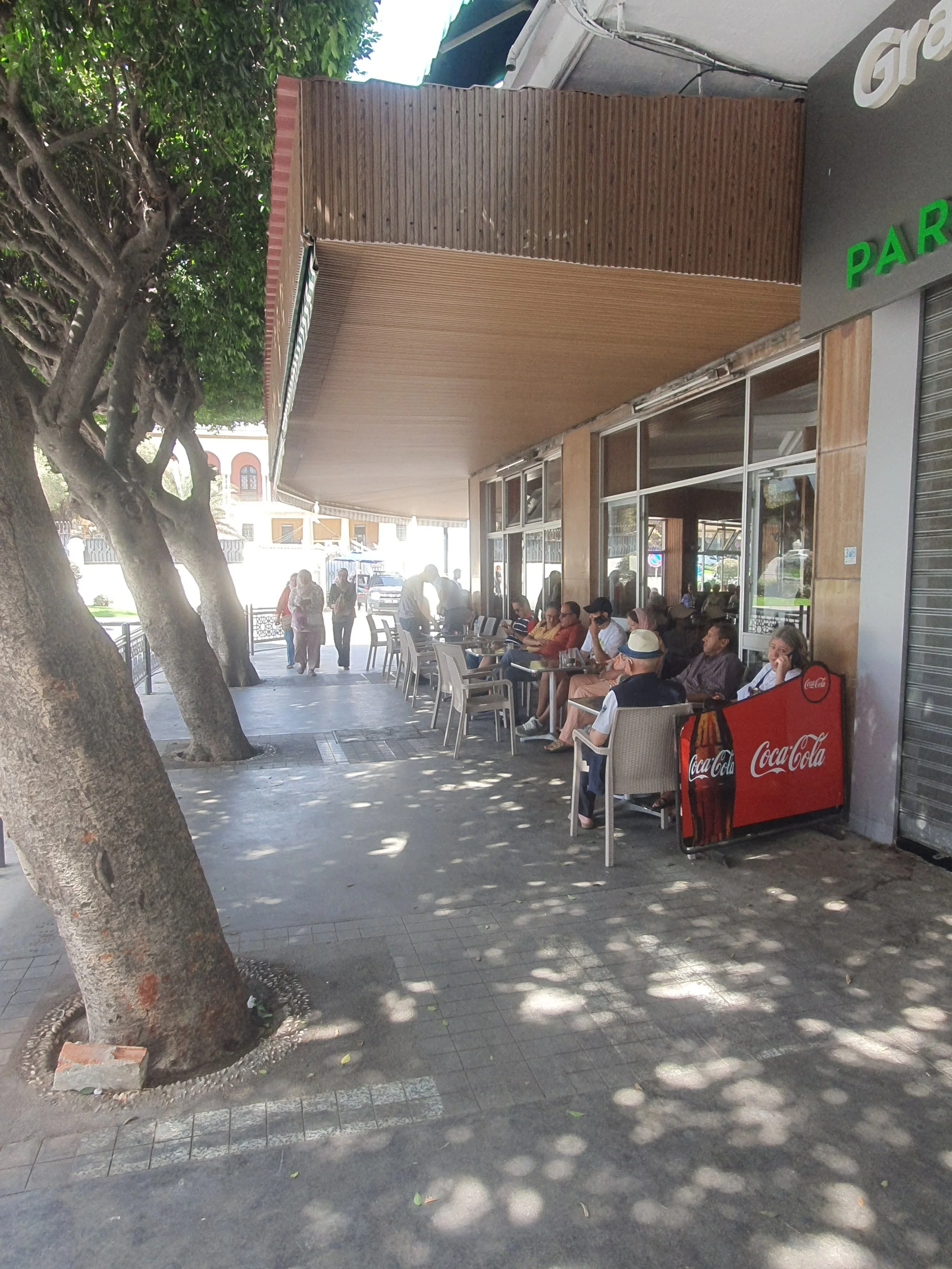
Gran Cafe de Paris across from the French embassy - popular with tourists, expats, and locals, and an excellent landmark, on the Boulevard.
9 Buying Souvenirs
On the whole, there is a high level of honesty in Morocco. If you drop your wallet or phone, someone will probably chase you to give it back. But the tourist shops may vary. Don’t buy at the first shop you see something – ask the price, and if on the second or third ask the price is the same, then make your purchase. It is always worth confirming the price first before you order – don’t assume. And feel free to bargain in the market places and tourist shops.

for sourvenirs, I absolutely love the ceramics - but it just won’t fit into my backpack. I had to give my two beautiful bowls away.
10 Taxis
Each city has a different taxi system with different owners. In Tangier, the blue taxisare share taxis and very cheap for short distances (Getting Around in Tangier - Transport) . You say where you want to go, and the driver will accept you if it fits with his other passengers.
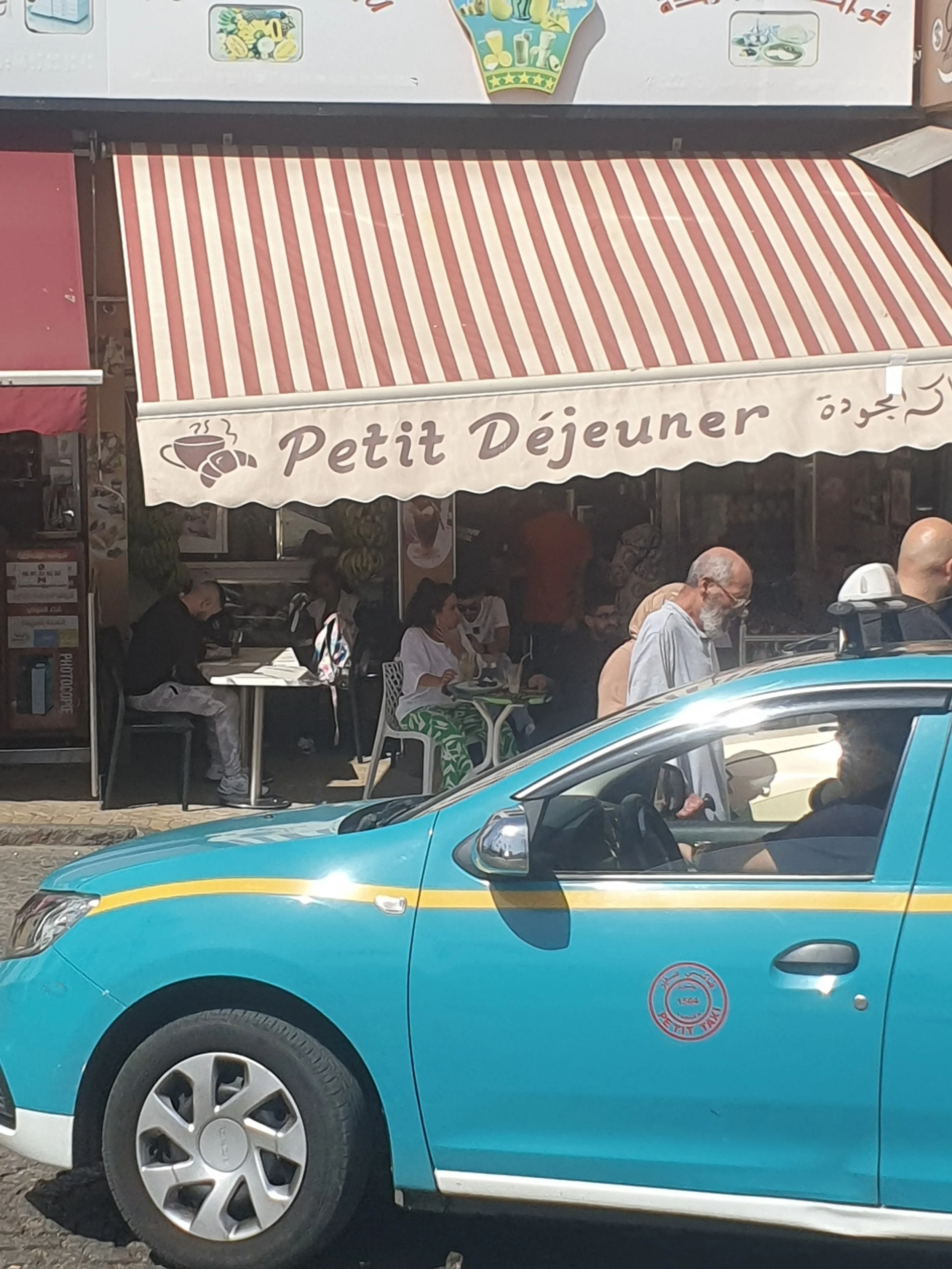
A blue share Petit Taxi. Every city is run differently.
Most in Tangier are good and decent hard working people, but like everywhere, not always. Make sure the meter is on. It has a separate meter for each ride, 1.60 flag fall (2.40 after about 9pm). The fare is one for each group. If your ride is 10dhs, you pay 10dhs whether there is one, two or three of you. Their maximum capacity is 3.
Minimum fare is 7dhs, even if it’s a very short distance. At night it is 1 ½ times, so a 10.50 dhs minimum fare (from about 8 or 9pm). From Café de Paris to the train station should be less than 10dhs. From the below the Continental Hotel/across from the ferry, about 12dhs.
11 Restaurant Caveats
Some restaurants may also try tricks. I found this especially in the Jemaa el Fna Square in Marrakech, but also a couple of spots in Tangier – the ones in Grand Socco that pester you with menus. It is normal for bread and olives to be brought as part of the meal, but some may also bring salads and other extras, then ask you to pay for them even though you didn’t order them. If there is ever a situation, a solution that invariably works is to suggest asking the police. If they are taking you for a ride, this invariably solves everything on the spot.

This is my favourite restaurant, and top of My Top 10 Food Spots in Tangier. - The Syrian, or Abou Tayssir. Mixed dips (humus, baba ganoush, and the yoghurt baba ganoush), and the fatoush salad.
12 Water
Any blanket statement that the water in Morocco is undrinkable is wrong. It varies by the city, and you need to ask. I can guarantee that Tangier water is perfectly okay from the tap. I have been drinking the tap water in Tangier for 4 years! Chefchaouen (The Blue City) has excellent water – it comes down from the mountains.
But check this city by city. I often ask the locals whether they drink the tap water to get a real answer. I don’t like contributing to the plastic waste of the bottles.
I drank tap water in Fes, and Erfoud in the south. In Agadir at the time I was there it even smelt bad, so I most certainly didn’t drink it, but this may have changed. I think Marrakech is a place that bottled water might be better. Just ask in each new location.

Water comes with tea and coffee. Tourists are usually given a bottle, but in Tangier I ask for tap water and drink from the glass.
13 Food Safety
The food is also good in quality, especially in the little shops such as the ‘sandwich’ shops. As with everywhere, see who goes there. If lots of locals do, then the food is good. The locals already know where the good places are. These shops are small, so they have a high turnover with fresh food daily.
When I first came to Morocco I read that there was no refrigeration, and the food was unsafe! Morocco is not in the depths of Africa or Asia. It is a modern and developing country. In fact, the only place I have bought bad meat in Morocco was at one of the big supermarket chains (There are two, Carrefoure and the Moroccan one Marjane). I avoid these shops because they are expensive and their vegetables are not good quality.
The vegetables at the little shops, the markets, and being sold by the ladies with the red and white striped aprons, were probably still in the ground while you were eating your breakfast. The meat was walking until it was needed. And the fruit in Morocco is amazing!!! The little shops around the medina in Tangier are honest with their prices, and some now show their prices. Pick your own so you know what you’re getting. But don’t be shy – fruit, dates and nuts. Food quality in Morocco is good.
If you need anything else, the little shops – by law – are cheaper than the big supermarkets, and more convenient since they are everywhere.
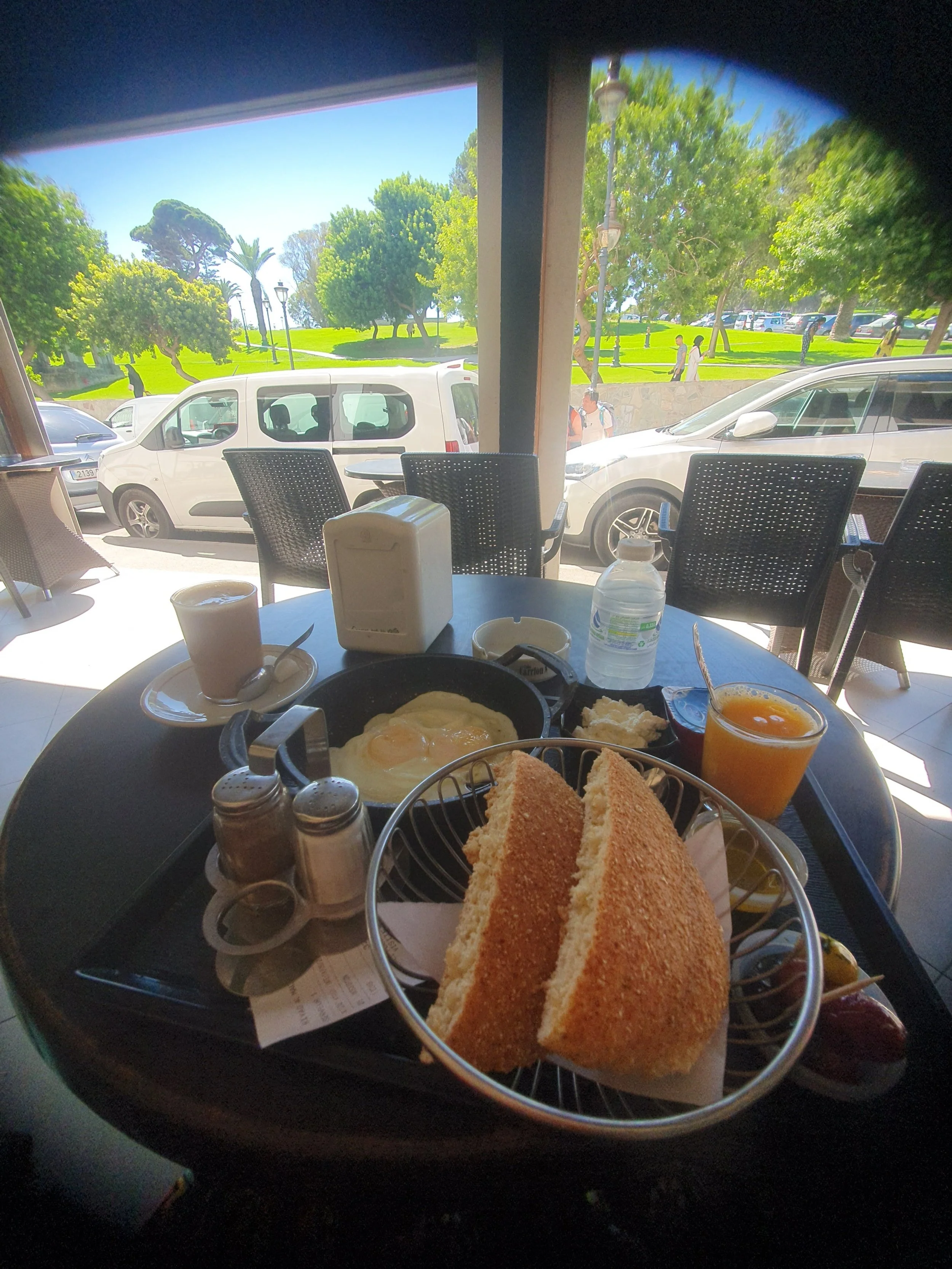
Breakfast before I get into work.
14 Eating with your Hands
Morocco is a tourist country and accepting of your ways. They will automatically bring cutlery. But if you want to try the Moroccan way of eating with your hands, it is easy – and fun. Just tear off a piece of bread and use it as a spoon with your fingers. Watch how they eat, but there’s not much of a trick to it. Just use your thumb and first two fingers. It is even considered good luck to lick your fingers! Oh, and use your right hand.
As I said, Islam is a very clean religion. There will usually be a basin to wash your hands before and after eating. And you won’t be given salt and pepper – it is salt and cumin, with vinegar and very virgin olive oil. You can always ask for more bread.

Best way to do it right - be too hungry to care and just do it without thinking.
15 Cafes
You might feel intimidated by cafes full of men, and confronted by rows of them lined up with their backs to the front wall of their café. But there is nothing wrong with a woman going into a café. Generally, they simply spend their time elsewhere, and the men go to the cafes. You will probably be looked at, but it is purely curiosity, not taboo. In my experience, the best tea and coffee is the cheapest, and to be found in these cafes.
Besides, the Moroccan mint tea is a must-try. Just be aware that it comes very sweet. You can ask for it without sugar – bla sukkar. They may argue that they can’t do that, but they can. Be firm and you will get what you want. Go to one of these cafes, sit for a little facing the street and watching the world pass by. This is one of my favourite parts of Morocco.
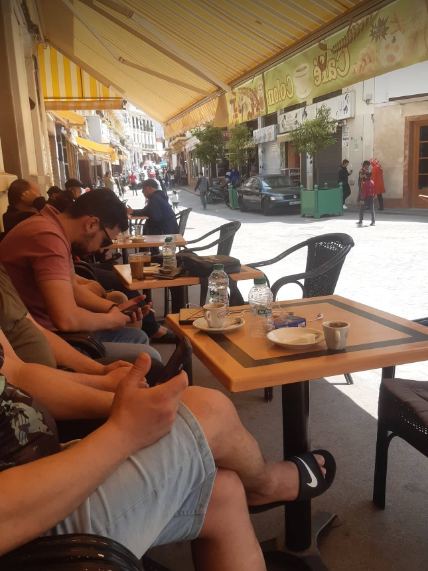
I no longer even notice that most cafes are just men. But I do enjoy to sit and watch the world go by. Cafe Colon.
16 Wifi and Data
If you don’t have roaming data, you have 2 options in Morocco. Most cafes, restaurants, and accommodation will have free wifi – just ask. Google maps and5 info can be downloaded for use offline. The wifi in most parts of Morocco is good.
You can also buy data. There are three companies – Orange, Inwi and Maroc Telecom. They are all pretty much the same. For about 50 dhs (€5) you can get 10gb of data. There are little shops everywhere which can sell this – just look for one with phones, or ask. (The airport charges double.)
17 Friday and Couscous
Morocco’s Sunday comes on Fridays – the big day in Islam. This means some businesses may be closed for the day or part of it. Don’t stress – Friday is couscous day. Go and find a spot to try this national dish. If you get out of the medina, you can get it for 30-50 dhs. If you want, you can ask for more of the sauce to pour over it.
18 Ramadan
Before your trip, check when Ramadan is. It is a lunar event, and changes by about 2 weeks every year. It is not so much a fun cultural feature. Just like Christmas Day in the west, it is mostly a family event, not a public one.
During the day in Ramadan, most restaurants, cafes and food shops will be closed, especially outside the medinas and touristy places. The few cafes open (Grand Café Centrale in Tangier is the main one) will be crowded since the usual range of options aren’t available. Opening hours also tend to be shorter. At night everything opens up, and after f’tour (breakfast) the streets come alive. But all bars will be closed, and some cities (like Fes) will be completely dry for the entire month, if that matters to you.
19 Beggars
Beggars are a worldwide problem, with variations by country. Morocco is generally a poorer country, but people usually look after each other. There are some who are down on their luck, but over time I have realized that most beggars are just playing on guilt tripping tourists, and I can’t usually tell the difference up front. I would like to give, but most of them are variations on scams. This is obviously a personal choice, but over time I have decided not to give to beggars – ignoring them is usually the best approach. Instead, I give by always tipping – even for a 10dh tea – and giving to buskers. And I will give food (most refuse).
20 Street Cats and Dogs
Morocco has loads of street cats. They are generally well looked after, fed and patted by the locals who save their table scraps and buy tins of food for them. There are less dogs, but they are also safe. They are vaccinated for rabies, and have a yellow tag in their ear so that you know they are treated. As an ex meter reader needing to be very careful of dogs in back yards and bitten twice, I can assure you that I have never felt alarmed by the street dogs in Tangier. The cats are so at ease that I have even seen them sleeping peacefully in the middle of a pathway with feet stepping within inches of them – they know they are safe.
Having made these warnings, while these things can happen, they are not the norm in Morocco. Moroccans are friendly and welcoming and generous people. They would invite you home to eat the last of their food before letting you starve on the street. Several times when I have seen a lady fall over, she is immediately surrounded by 4 or 5 people, given a chair to sit on, a glass of water, and they will stay with her and chat to her till they are sure she is ok, and only leave when she is ready to get up and go.
This is a list of need-to-know things to save you confusion when you are first here. Morocco is a delightful place to visit, with a very different culture. It is full of colour and delights, with people who are friendly and welcoming and generous. Come to Morocco – without fear – the most likely disaster is that you will have an exceptional holiday and need to save up for a return visit!

A day when Spain is only a pale blur - that is not just cloud.

Everything on Visas to Morocco and How they Really Work
Visas to Morocco, and how they really work.
Visas and How they Really Work
9 Apr
Written By Zallee Pepper
Visas to Morocco
I have lived in Morocco for 3 years and loved it!!! I love that the rules are ambivalent. They are just a suggestion. Just like the way visas to Morocco work.
I love Morocco. I loved living in Tangier.
And I love that there’s always a way – that is so optimistic to me after struggling with the rules of the rich countries where it’s “damned if you do, damned if you don’t”.
Find out how it works, then make your own decisions. But this is how I’ve lived and worked in Morocco for 3 years – I even know someone who did it this way for 30 years!
Legitimate Visa to Morocco
First up, is that things are always changing. But in the end, Morocco wants the tourists and the foreigners.
The legitimate way is to apply for residency. This is cheap, and straightforward. But it is an annoying amount of paperwork. But it will give you some extras that a tourist visa doesn’t.
You can get a proper bank account (be mindful that the dirham is a closed currency, so transferring out isn’t possible via a bank account). You can buy a car. You can stay without worrying about border runs.
Of course you will need to prove adequate living funds from overseas, but for Morocco this isn’t huge.
The other Way Visas to Morocco Work
The other way, which is the way most people around me followed, is with a tourist visa. As long as you can enter Morocco with a tourist stamp at the border, this is an option. The rich countries are very tied up on visa legalities, and there isn’t one that I would try to push the rules.
But if you are moving to Morocco, it is good to understand that rules aren’t black and white in the same way as we understand them. Things work differently – as happens across many cultures.
This is how it works in Morocco.
Tourist Visa
The tourist visa gives you 90 days. Within those 90 days, you need to leave Morocco. I lived in Tangier, which is close to Europe. Many times I just went to Spain for lunch – that is enough.
From Tangier, you can catch the ferry to Tarifa, have a nice lunch, a beer in the sun or a sangria and tapas at my favourite pub at the top of the medina next to the gate – Bossa. Then hop on a ferry and be back in time for dinner.
The ferry takes about 40 minutes (maybe an hour or 2 with faffing). I have set out the complete how to in a blog on ferries from Spain to Morocco.
Your second quick option is a taxi ride to Ceuta in a grand taxi. (Also set out in that blog). The ride takes about an hour along the coast with views of Spain across the sea for most of the way, and is less than 10 euros each way. Again, back in time for dinner. If they ask at the border I say I was doing some shopping – my bag will always prove me right, filled up with cheeses, pork, and alcohol which is way cheaper than in Morocco.
There are also lots of cheap flights, especially to Spain. I’ve heard of 30 euros return from Tangier to Rome. Casablanca is the biggest international airport, and will have cheap tickets, especially if you book ahead. I’ve also been told that you can get cheap flights from Essaouira to Marseilles.
On return, they simply stamp your passport for another 90 days.
Overstays
Even if for some reason things go wrong and you overstay, for the first time or 2 especially, fixing an overstay is easy – as long as you do it the right way.
If you try to leave without fixing your visa overstay, be aware that all hell will break loose.
You will be made to get the paperwork fixed before you catch your flight, which can easily mean missing it. And on your return there will be a court attendance and a fine.
But there is such an easy solution. The first time or even 2 you are unlikely to get a fine, even the third time if you have a very good reason.
The how-to was information given to me at the wilaya – the police headquarters immigration office in Tangier.
By all means, check this up for yourself. But this is how it works, especially in Tangier. (My first overstay was almost 2 years. Since then I have maintained a 3 monthly trip routine).
About 3 days before you leave, go to the wilaya with:
· Your ticket
· Your passport
· Your visa
· Proof of where you’ve been staying and
· 5 Passport photos.
Get 5 copies of each – there is a copier shop right next to the wilaya in Tangier.
Most of the process is then waiting. They may even ask you to come back the next day, and you must make the application with a full 24 hours spare before your departure. But the paperwork itself takes about 20 minutes.
I went early to immigration to make sure, but the worst case is a bit of a wait while immigration makes a phone call confirming your extension. I waited just 10 minutes.
Drawbacks of the Border Run
The main drawback is that you must take a ‘holiday’ every 90 days. You also need to keep in mind that in Morocco, everything is fine until it isn’t. Most of the time everything is fine, but it is worth being aware that sometimes, as with everywhere, get someone on a bad day and they can make things a bit more difficult for you.
I have heard of people being told at Ceuta they have to wait 24 hours, but I have never experienced any problems at all. I just smile and say I had a good day of shopping and eating tapas. They haven’t even checked my bags for customs.
As always, take into account the consequences and decide what works for you. But in Tangier, this is how it works.
If you want a bank account, to buy a car, or find the idea of these 3 monthly trips tedious, get yourself residency – first one is one year, second is for 3 years, third and after is for 5 years.
If, like me the residency seems like too much paperwork and you’re happy taking a holiday every 3 months, then the tourist visa is easy, and nobody will check whether you are working, or stop you at the border.
Over time I found I didn’t even have to keep track of my 3-month limit because I was starting to trip to Spain to meet friends and explore new parts more often than that.

How To Get Around Morocco and Tangier - Insider Secrets
Getting around Tangier and Morocco - trains, taxis and buses and local transport. Learn the insider secrets and local know-how
Getting Around Morocco and Tangier
Insider Secrets
I constantly see wrong information about getting around, and to and from Tangier, even from Moroccans (who don’t live in Tangier). Get the insider secrets – the local know-how.
There are three ways of getting around Morocco, and which is best depends on where you are (unless you have big budget constraints). $ fares are approximates in US dollars in 2024. Euros are about the same.
TRAINS – Heading North-South in Morocco
Going north-south from Tangier (Tanger Ville station) to Casablanca (Casa-Voyageurs station) there is the beautiful El Boraq bullet train service. This is linked into local train services (by that, I mean the timetable is designed for convenience) to Fes, Marrakech, and the airport.
Tangier to Casablanca is 2 hours, 250dhs (about $25) and runs every hour or 2. There’s a food car with some basic options which are reasonable.
To the airport there is a direct link. It takes about 20 minutes plus waiting time, and stops right at the terminal.
From Tangier to Fes takes 3h15. You change to a local train at Kenitra, 1 hour from Tangier. Usually this means nothing more than stepping across the platform and waiting 10 or 20 minutes – way easy. Just book a ticket to Fes (they will tell you about the change) normally 172 dhs. ($17). The line can go all the way to Melilla, the Spanish city on the coast (by that, I mean Spain). There are ferries from Melilla to Malaga.
You can also then get to the south to Erfoud and Merzouga by bus from both Fes (and Meknes – Fes would have more options) – a bit more than 100 dhs one way.
From Tangier to Marrakech takes 5h20, which seems to me good time for somewhere so far. The change is at Casablanca. You will need to change platforms. There are cafes etc for food – Casablanca station. The fare is just under 500dhs ($50).
Buying the Train Tickets
To buy tickets, easiest is at the train station itself. I usually just allow an hour before the time I wish to go. Online often doesn’t work – may be related to the currency of the card. The only likely problem is if it is a public holiday. If it is, I’d recommend booking a good week ahead. Otherwise, if the timing really matters, get your ticket a day ahead.
GRAND TAXIS – Heading East-West across the top of Morocco
East-West across the top of Morocco, the best way to get about is via grand taxi. They are like a mini bus service, with fixed routes and fixed fares. They are usually fawn or khaki coloured. You will see them all lined up in many spots around the city. The trick is knowing where to go to catch the one you want, but the share taxi drivers will usually be able to tell you.
They take 6 people, and go as soon as they fill up. Most of the time you won’t wait more than 10 or 20 minutes. If you are in a hurry, you can always pay for extra seats. For any distance, they are cheaper than the blue taxis. They run to the south to Boukhalef near the airport, near the new CTM station, to the market suburb of Casabarata… Just depends on where you want to go. Those ones are mostly 5-15 dirhams, depending on how far the trip is.
If you want to go to the beach such as Achakkar, to Hercules Cave, they are about 15 dhs. Go to the Mediterranean beaches to the East to the beaches and the fare will be about 20 dhs – all depending on how far you go.
To the south to Asilah beach and medina is a bit more.
Old CTM Bus Station:
This stop is about 5 minutes taxi behind the train station and right on the train line, across the road from the old CTM bus station. The new CTM station is in the south near the airport. It also has grand taxis to these places, but it’s a long way from the medina. The fares will also be different.
You might get a taxi from here to get to:
Chefchaouen: Taxi stop is across from the old CTM bus station, a short blue share taxi ride behind the train station. (The new CTM bus station is down near the airport. They also have grand taxis to Chefchaouen, but it will cost a lot in blue taxi to get there).
Chefchaouen is just over 2 hours and doable in a day trip if you start early. The fare is 70dhs ($7)
Tetouan: A smaller city than Tangier, with some lovely beaches nearby, such as M’diq – about 20 minutes by another grand taxi. About an hour, the fare is about half for Chefchaouen.
Fnediq/Ceuta: Ceuta is another Spanish city, Fnediq is the one on the Moroccan side. Your main interest for this one may be for a border run. Just 70dhs ($7) from Tangier, border run ferries Algeciras. I always enjoy some sangria, beers in the sun, and tapas as well as shopping for cheese, preserved pork, and alcohol which is much cheaper than in Morocco. You can also get ferries to Spain, to Barcelona and Sete in France.
Tangier Med: is the ferry terminal a good 40 minutes from Tangier and on the way to Ceuta. Ferries go from there to Algeciras, which is right next to Gibraltar. Note though, that the Tangier ferry which goes to Tarifa has a free bus included in the fare which will take you the 20 minutes to Algeciras ferry terminal.
Morocco - The South
Unfortunately, in the south your options seem to be buses. I believe it is about 4 hours from Marrakech to Essaouira or Agadir.
And of course, there are flights across Morocco. If you want to go to Agadir from Tangier, your best way is probably by plane. And don’t forget – Dakhla. Have yourself a different experience by visiting this desert seaside holiday town.

Everything on Ferries from Spain to Tangier
Everything you need to know on ferries from Spain to Tangier in Morocco
How do I get to Morocco from Spain by ferry?
Everything you need to know:
Updated 23rd September, 2025
The Ferries
There are 3 ferry options to Tangier.
To Morocco, it’s also possible to catch a ferry to Ceuta which is still Spain, and walk across the border there and use a grand taxi to Tangier which takes about an hour. Or you can catch a ferry to Melilla which is across from Nador and closer to Fes, by train.
Way 1: From Barcelona, if you’re cruising for time, there is a ferry to Tangier Med. It takes about 3 days.
When I did the trip (in reverse) I took the bus from Tangier. I bought the bus ticket at the Tangier port ticket shop, from Tangier to Barcelona.
They taxied us from the Tangier port to Tangier Med, we took ouselves through customs etc, got the ferry to Algeçiras, then caught the coach to Barcelona which left me a long way from the port and city centre there. This was over 4 years ago and took about 20 hours in total. The coach seating space was very! small. But it was cheap - the cheapest option.
Way 2: If you get yourself to Algeçiras (I prefer blabla car over bus, but both are options, and if you have a lot of luggage the bus might be a better option), there are 2 ways.
The ferry which departs from Algeçiras is a little cheaper than the Tarifa ferry, but it goes to Tangier Med, leaving you to work out how to get to Tangier city (Tangier Ville), which is close to an hour away. There are grand taxis which are reasonable, but thats a bit to work out when first landing in a new country, especially if a bit tired and luggage laden.
Way 3: The other way is from Tarifa, which puts you at the foot of the medina. If you buy your ticket at Algeçiras, it includes a free bus ride to Tarifa - a very pretty journey with some lovely views of Morocco across the water. The bus is designed to meet the ferry both ways, and takes you to the port.
Of course, you can go to Tarifa directly and buy your ticket there, especially if you're coming from elsewhere in Spain
Carts for luggage
The buses stop just to the right of the main gate, where you can find carts if you have a lot of luggage.
Tickets
Its easy to buy the tickets inside the terminal. Off season there's no need to book. Just arrive about an hour before the departure time. They run every couple of hours for most of the day.
The cost of tickets is around €25 each way depending on the exchange rate. They are valid for one year, and your booking date can be changed at any time, even if you missed your booked ferry!
Return tickets can be bought for discount.
Passport Control
Passport control into Morocco is done on the ferry itself. Most people rush to line up for it, but I prefer to find a seat first and sit. I've noticed that the queue gets short after a bit. The actual trip is just 40 minutes, but departure time seems to be at the whim of the ferry people. It's a 2 hour window, because that ferry is scheduled to go back to Tarifa 2 hours after its Tarifa departure time.
Alcohol
The official limit for alcohol in coming into Morocco is 1 litre, but the rules are very flexible here. I've brought in as many as 6 bottles through Tangier and Ceuta (total price of spirits is about the same as one fancy brand in Morocco), and nobody cared. I wouldn’t try this at an airport though.
Money
Dirhams are a closed currency and not supposed to be taken out or available outside Morocco. I have occasionally heard of someone getting some before arrival, but it's really not necessary, and a good chance you won't be able to. At the terminal in Tangier you will walk past some ATMs on your way to the door. Just use your card and withdraw some dirhams that way.
Morocco is one of the most cash-based countries in the world. Mobile apps are unlikely to be available for payment in most places, and only some places accept cards, generally the fancier tourist places.
But that shouldn’t be a problem. Cash machines are everywhere. You can withdraw up to 2000 dhs in one go, some may let you take more. The cheapest is CdM - Credit du Maroc with the blue sign, which only charges 22dhs instead of 35 dirhams.
You can also bring cash - euros are the beat, followed by usd, then GBP.
There are also plenty of exchange bureaus around the medinas, and to be found elsewhere. Natually, the further you are from Touristy spots, the fewer there are. Like with everything, just ask at 2 or 3 first and you'll soon learn what rate/price is good.
There are also lots if CashPlus, Moneygram, and Western Unions around
For conversion, use ‘mad’. ie, put into google search "2000mad usd", etc. Currently €1 or $1 usd is around 10 dirhams.
Make sure to keep some receipts in case you need to change back when you leave. Morocco has a closed currency which means the dirhams are not supposed to leave, and as a result will be extremely difficult to sell outside Morocco. No one wants dirhams - not even thw Moroccans lol
Where to Stay
Now, where are you going to stay?
Look up Tangier. Most people want to be close to things. The yellow bit at the top of google maps. This is roughly where you want, including the non-yellow bits to the north of it. The green wiggly bit is the medina. If you want to be away from everything, you might like to try Asilah south of Tangier, beach and beautiful. But most people want to be near the medina where everything is.
I usually look up booking.com and explore the options there. Pick any one, then check it on the map. I then choose from map location and price, finding it the easiest way to narrow down what I want.
In and around the medina you can find lots of places with a great variety of types of options – everything from dormitories in hostels to the lovely boutique hotels. Many of them have rooftops and sea views – Tangier is blessedly hilly, so many places have views of Spain and the Mediterranean. Check my blog on where to stay for more detail.
Taxis and Transport
Once you’re through the gates of the ferry terminal, how do you get to your accommodation?
If you have little luggage and are up for a walk, you are at the base of the medina. Most places are in 10-15 minutes walking distance, unless you have booked down near the train station or Malabata along the far end of the beach, or somewhere further out from the medina.
If you need a taxi: From the port gates they generally want to charge more. If you have a lot of luggage you will need to take this option. If you want to save money, walk a little along the big road (called the Corniche), to your left from the gates.
Taxis aren’t expensive. The blue share taxis are likely to cost around 10 dhs give or take, half as much again if it’s after 9pm. Minimum fare in the daytime is 5dhs, at night is 7.50 dhs. Just make sure they put on the meter for you. Most of the medina is accessible either via Souq Barra (the markets at Grand Socco/Cinema Rif), or the Kasbah, depending on which end you are staying.
Most taxi drivers are decent. Round the fare up to the nearest dihram. And be mindful that the roads in the area are mostly one-way streets – more likely to seem like a detour and a roundabout trip when you’re leaving than entering the area. But a taxi from the kasbah can seem quite circuitous.
The big pale yellow Mercedes sedans from the 80s are normal taxis and up to 4 times as expensive. With them, make sure you ask and negotiate the price first.
There are also grand taxis, like mini bus services, but probably not your method of transport from the ferry to your room.
Once you are settled into your room, read my other blogs on where to eat and where to go out at night.
Enjoy Tangier.