I Didn’t Order a Turkey from Cairo
And the Dangers of Travelling in the Middle East
My phone rang. Unknown number, but I’d been waiting for a few calls. Could this one be from one of the agents offering to represent my book?
“Hello.”
Arabic.
“Do you speak English?”
More Arabic.
“Who are you?”
“…delivery…, ” and lots more Arabic.
A scam, I thought. I was about to launch into my Darija swear words from Morocco (rather more prolific than my nice Moroccan Arabic words), but something made me pause. A scam would usually switch straight to English and launch into their spiel. I grabbed a passing waiter by the elbow and gave him the phone.
After what seemed like a long conversation he turned to me – you ordered a turkey from Cairo.
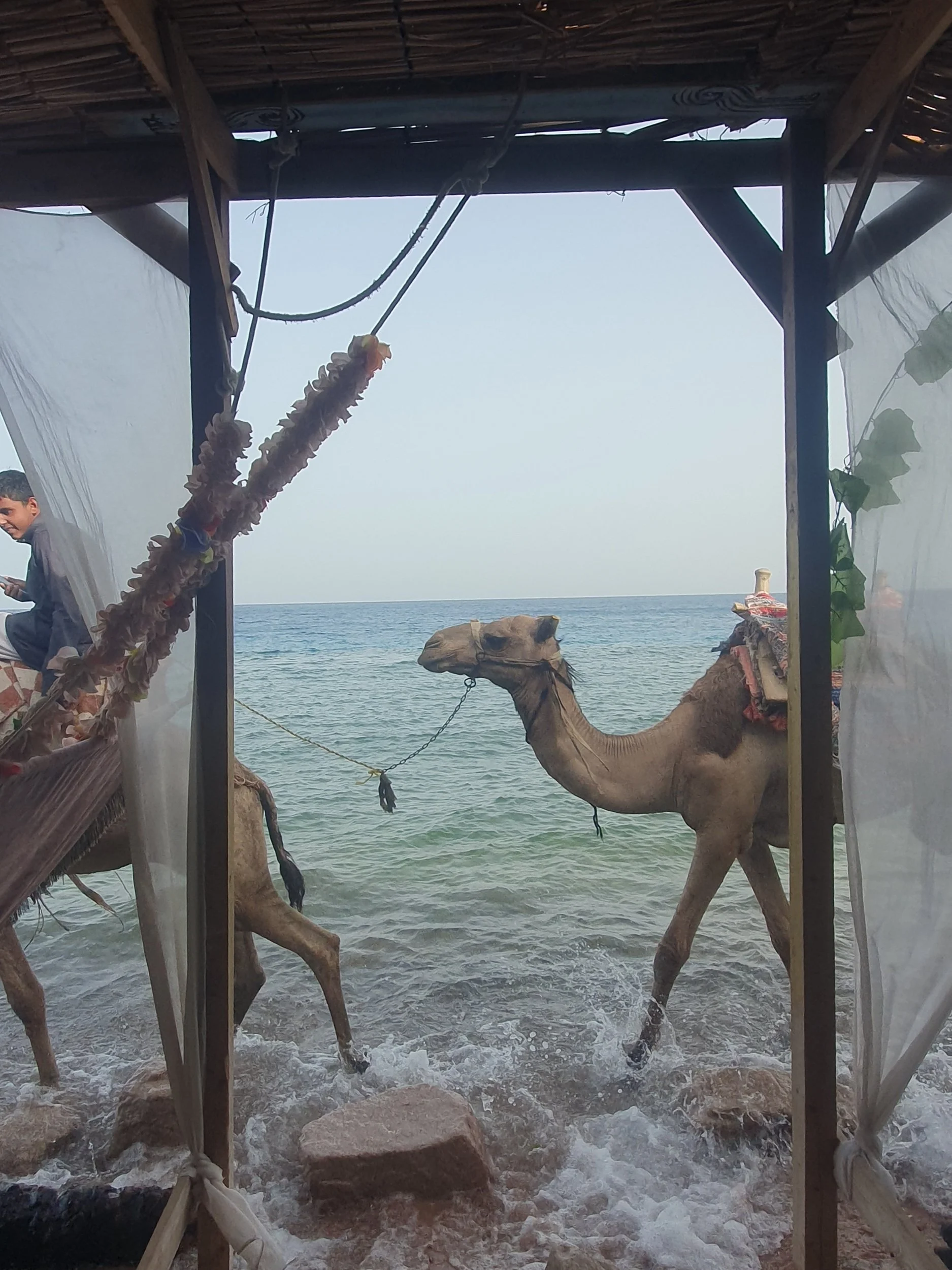
I was in Dahab, a 12-hour overnight bus ride from Cairo. No interest in turkeys. Not even chickens, except to eat them.
‘No,’ I tell him. ‘I didn’t order a turkey from Cairo.’
Now, that is a sentence I had not anticipated saying when I woke up this morning.
I mean, I could relate. This is a place where supermarkets are more like markets that happen to have four walls. They sell all manner of goods in tins and jars and bottles, a collection at the front of sacks of fava beans and pasta and chick peas and rice and nuts and sultanas and so on to be ordered by weight. Add to that huge tins of spices, and select your eggs out of a bucket to balance carefully in a plastic bag for the trip home.
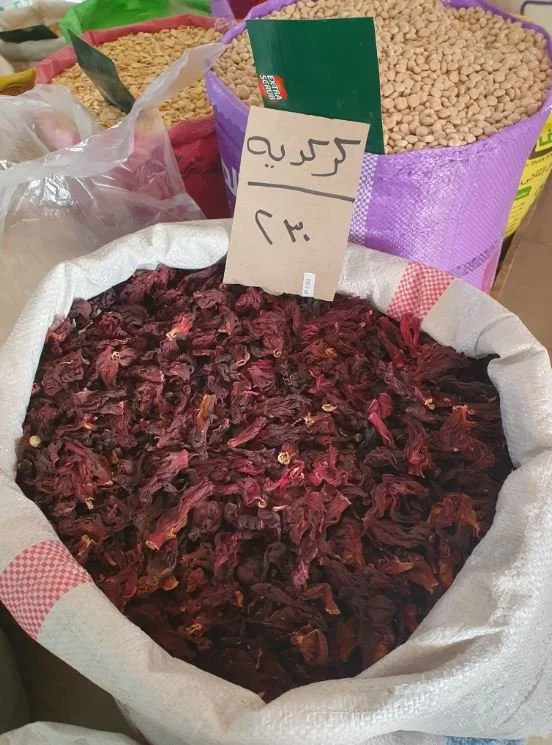
Kakadei - chamomile flowers to make tea, 63 Egyptian pounds, according to the sign. Buy by weight, boil up a big batch, drink hot or cold, with or without sugar.
Turkey, or chicken, is not to be found in those shops, either running around or chopped up and packaged.
Meat is a little easier – the butcher is identifiable by the stripped carcass out the front. You point to the bit you want and it will be carved off. And to be fair, there are also shops with live turkeys strutting around in front of them.
But if you didn’t grow up on farms like I did, watching calves being born by the age of three, and keeping my father company as he slaughtered a sheep hanging from a low branch of the big old banksia tree up near the shearing sheds for our meat supplies for the next month, and calling our dogs pandas because they were all black and white like my stuffed toy panda bear – if they aren’t in your experiences, you might prefer to be a vegetarian rather than buying chicken in Egypt. The little shops aren’t the most aromatic – in any good kind of way. The chickens squark in their coups. You point to the one you want, and it is retrieved with a good deal of fussing by the chicken.
I won’t go into detail. Suffice it to say that the chicken is undeniably fresh, and halal - slaughtered to fit Islamic lore.
But Dahab was not my destination, just a spot to chill for a month or two as I passed through.
Again.
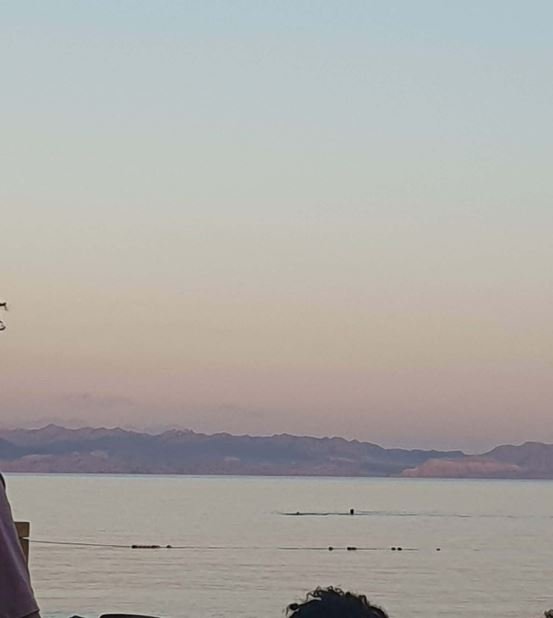
Saudi Arabia, across the Gulf of Aqaba from Dahab in the Sinai.
It’s on the south Sinai facing the Saudi Arabian hills, a desert peninsular with the unique characteristic of being part of a different continent to the rest of its country. I believe there are only two other countries which have this claim. Turkiye is the best known one. Istanbul straddles the Bosporus Strait and across Europe and Asia. North of Turkiye, Russia is split along the Ural Mountains, also across Europe and Asia.
And Egypt? While most of Egypt is in Africa, geographically the Sinai is in Asia, split along the Suez Canal.
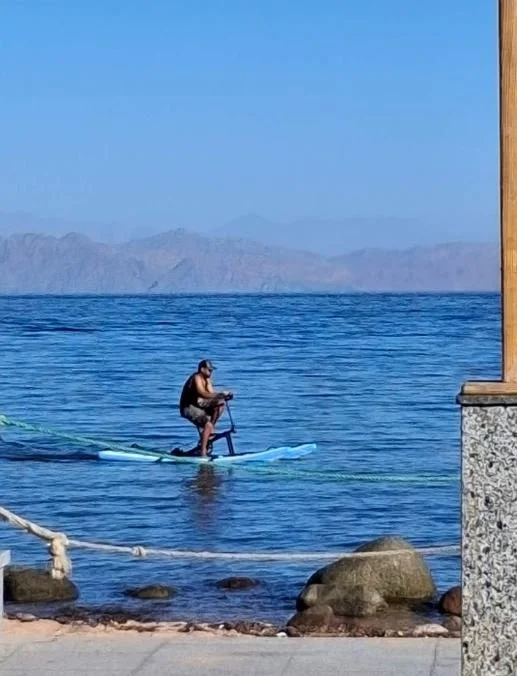
In the water in January - well, technically on. But in is good too. Saudi hills in the background.
But I am leaving Egypt, heading closer to the Gaza danger zone. Egypt has been completely safe – even as a solo female traveller. In Dahab, half the shops lock up at night by placing a stool in their doorway, or sometimes just a stick slanted across it. At one restaurant there were 5 old fashioned box TV sets stacked up half way across the doorway. I’ve even seen some shops with their goods left outside on display overnight. The most serious issue here is the electric scooters, a few of which are driven fast. And the danger is mostly to the dogs which don’t always pay attention.
Also, another danger, currently being winter, is the wind. The daily temperature is consistently around 23 degrees (73 degrees F), but the wind makes it cold. I mean, I couldn’t stay in the water snorkelling for more than half an hour or so - although it was the getting out that was chilly! I’ve also got myself into trouble having too many coffees and gazing off at the Saudi hills when I should be focused on my laptop. Or starting up an interesting conversation with the next table which lasts for half the morning. But being distracted and procrastinating is a well-honed skill.
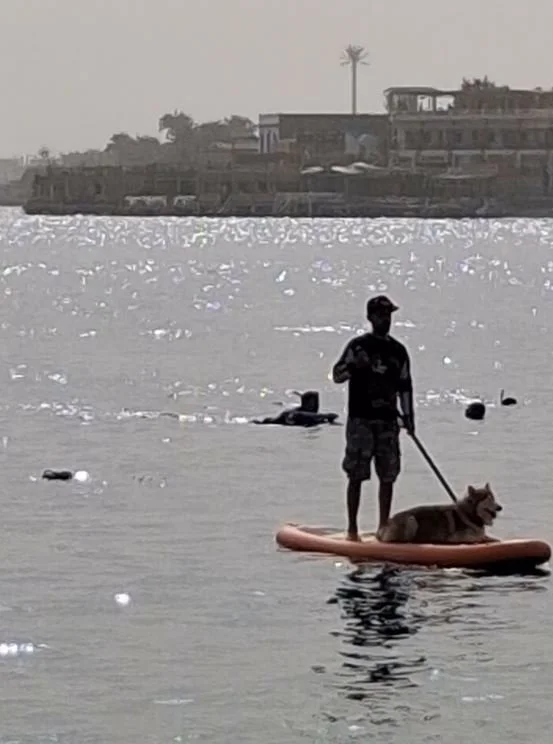
Every man and his dog in the water…
These serious dangers aside, fun fact: There are six points on earth which are tripoints – places where 3 countries meet and you can stand in three at once. There is just one place on earth where you can stand on four countries at once, with its own name for it – one quadripoint. This quadripoint is in Africa, between Botswana, Namibia, Zambia and Zimbabwe.
But there is another spot. You can’t quite stand on all countries at once – but you can see four countries at the same time. As you cross the Gulf of Aqaba on your way from Egypt to Jordan, you can see both of these countries. You also have clear views of Saudi Arabia, the border of which is just south of Aqaba on its east side. And on the next hill in Aqaba to itsthe west you can see the lights of Palestine-Israel. Aqaba is one city, split by the fence and called Eilat on the other side.
And this is the entry point into Jordan, literally a stone’s throw away.
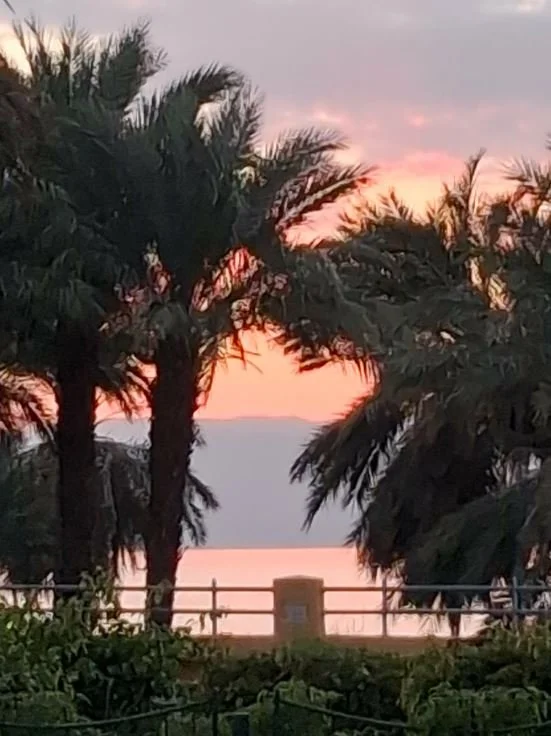
Looking over the beach at Aqaba in Jordan across the water to Israel-Palestine. Just half an hour down the coast to my left is Saudi Arabia, less than 30 km away. Even closer, just to the left of the photo on the other side is Egypt. From the ferry, all four countries are easy to sea at once.
So, leaving this warm paradise of Dahab behind, I make my way up to the Jordanian-Israeli border with my friend and one other. Here is where the dangers started to multiply out.
Our first danger came when the ferry did not leave anywhere near on time. And even when we arrived in Aqaba on the Israeli border, we were stranded.
No – nothing to do with Gaza or any troubles there. There was an expensive yacht owned by somebody rich and significant, already docked. We simply had to wait until they were ready to leave. The ferry ride scheduled to leave at 1pm mostly involved just waiting – at both ends, and biding our time. The 1 hour trip from Nuweiba in Egypt got us into Aquaba in Jordan around 5pm
Finally on the ground in Jordan at passport control, the travelling companion decided it was a good time to start making jokes about my surname, right in front of the security guard.
You see, I have often commented that I need to change my passport back to my previous married name, which is Puetter – an anglicized version of my husband’s German name, Pütter. Much to everyone’s amusement, including my own, this surname does not work well when said badly in Spanish or French – which at this point in time includes every time I try to speak in either.
In both languages, putta (said poo-tah) means prostitute. I am stranded without a decent name! (Hence Zallee Pepper)
However, much as this might amuse me and get me a bunch of laughs at parties, making a fuss about this in front of passport control in an overly loud voice was not a suitable moment - especially while in the next moment, again in a not-so-quiet voice she would say things like “I just want to kill somebody right now”. Would they double check my passport? Take me into detention? Lock me up?
Lucky for me, they either didn’t hear, or recognized it for what it was, and I managed to pass safely into Jordan.
We caught a taxi into the city and stopped for a Jordanian breakfast at a cheap table looking across the border to the next hill which was covered in the lights of houses of Eilat in Israel-Palestine. I am now located a 10-minute drive from the border. Many cross the border for work daily, either by ferry or the land border. But the border closes just after dark, so a late night for the boss is not ideal.
After a long bus ride northwards, It is quite late by the time we arrive at my friend’s place in Amman on the hill right next to the city, in the famous area of Rainbow Street:- A city of hills that at night time looks like a fairyland.
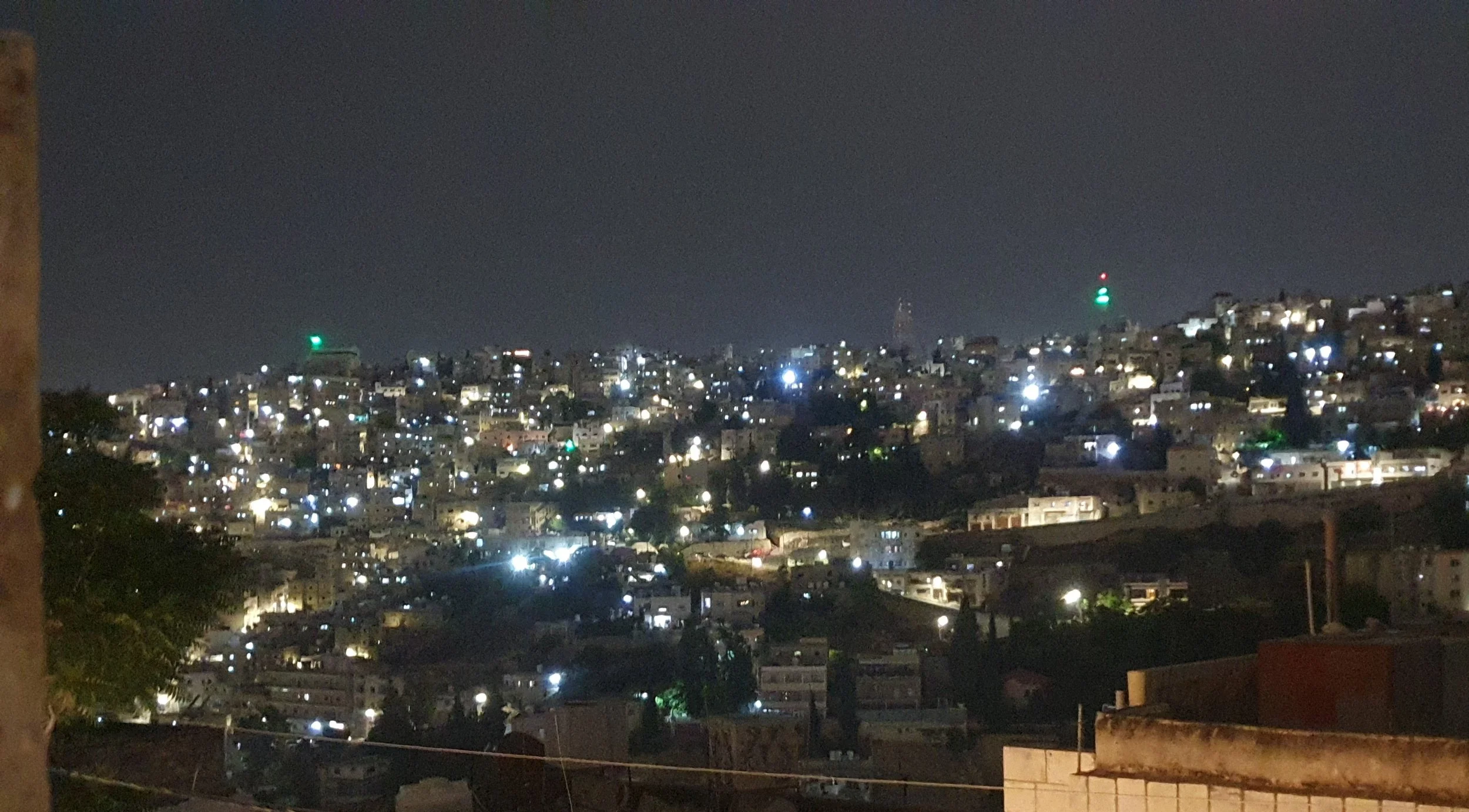
Amman’s fairy lights by night, looking across Downtown towards the Citadel.
I have a writing practice of noting down the two most obvious features that I notice in each new place when I arrive. I’ve realized that it isn’t a detailed description that places the reader in the situation. It’s about creating an atmosphere, best done by mentioning a couple of details that are unique to it.
San Francisco was the smell of dope and the moan of the fire engines – their sound really is a moan, and they’re constant. The city is still paranoid, even though the big fire was over a century ago in 1906.
Syros Island in Greece was cats, and a lot of very overweight men on very little scooters buzzing around everywhere.
Tangier is cats, cats, cats, and the prayer call, 5 times a day.
And Amman – also has the prayer call, and much prettier than the competing yells that seem to come from the Moroccan imams. Their other is a tune played in the streets. A very pretty one that already is a fond welcome whenever I go back. But what is its source? It is played at intervals all day, every day.
After quite a deal of fruitless tracking, I finally came across it by chance. It turns out to be the tune played by the gas man advertising that he is nearby with replacement cylinders. That daily sound, and someone nearby calling the pigeons across the rooftops early in the morning, then again at dusk.
Most cities around the world are just that – big cities with little to distinguish them from all the others. Amman is one of the cities which has a unique magic over it. I love that its original name was Philadelphia. Somehow, this classic Greek name meaning ‘brotherly love’ sets the tone for this ancient city. It is one of the world’s oldest cities continuously lived in.
It is a country of ancient settlements from the Stone Age making it a significant centre since around 7,000 BC, with waves of Romans and Greeks, Byzantine and Islamic influences, and the setting of many of the stories and places familiar from the Bible. The Dead Sea Scrolls – found nearby in the Dead Sea – are housed in The Jordan Museum. No wonder it has an atmosphere – it’s been working on it for a while.
Not least of all is to muse that the types of food have evolved from all the way back to the stone ages. While Jordan is on the expensive side for rent and night entertainment, the fresh produce in the markets is remarkably cheap and varied, and even in the restaurants – if you know where to go.
One classic is the Cairo Restaurant in downtown Amman, with a whole range of dishes that are uniquely Jordanian, which echo origins in ages gone by – including every part of the animal if you are game enough to explore. I found the food in Amman excellent. I now have some great recipes. I am a fan of every country where there is never too much garlic – including this one.
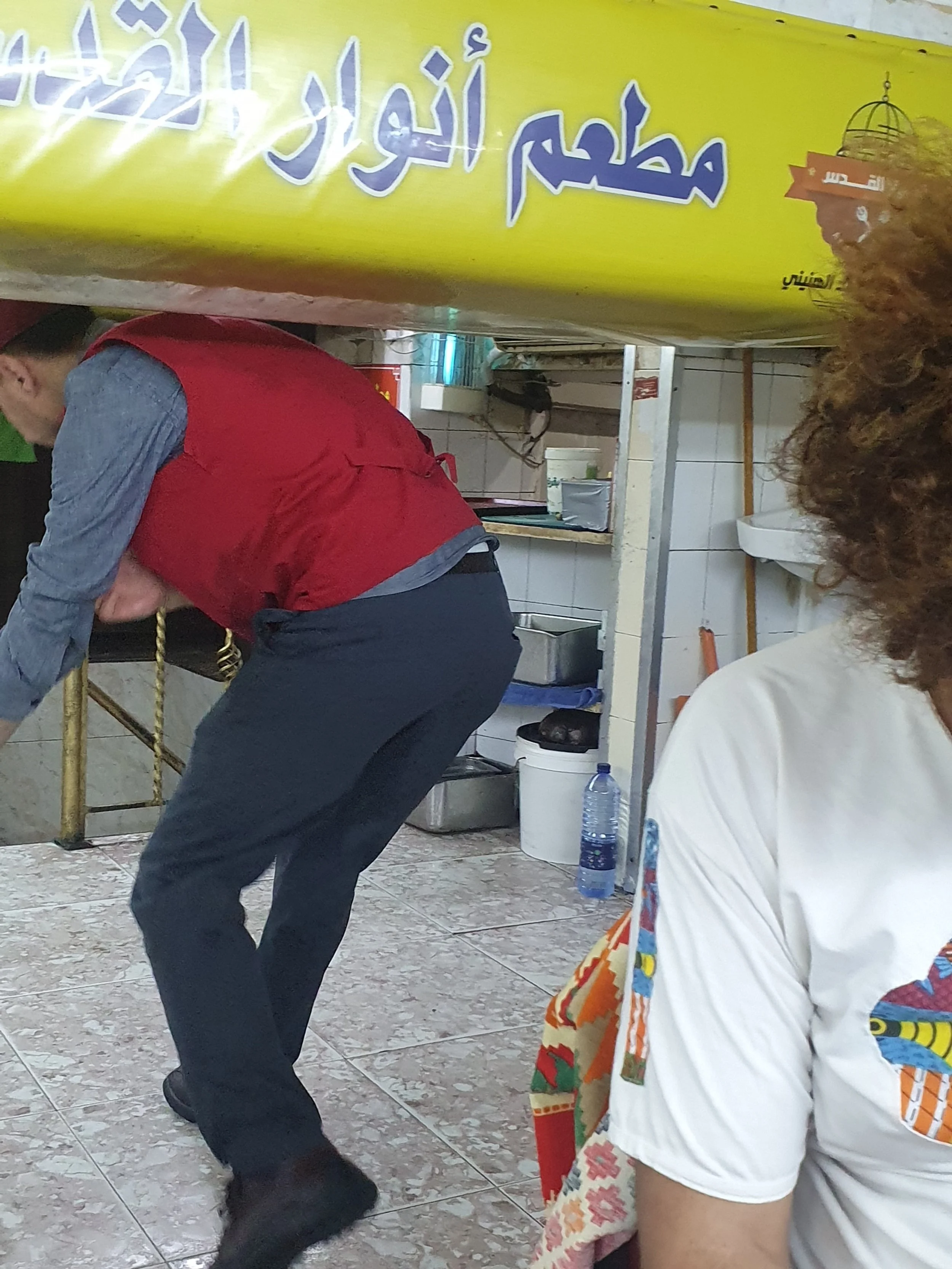
For some character, the beam is so low you have to duck to go under it, as this waiter is doing - Cairo Restaurant, downtown Amman
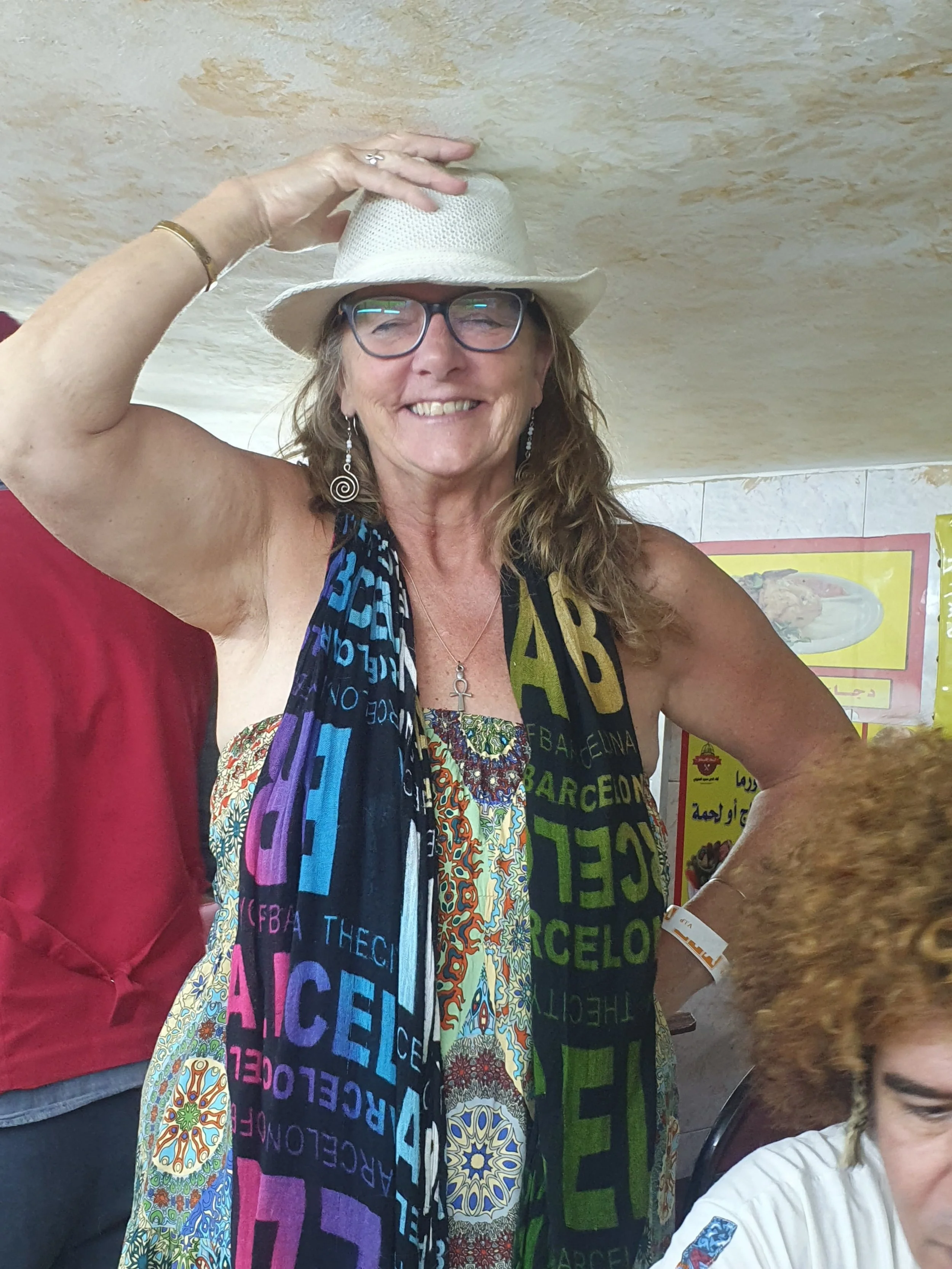
Even the ceiling is not the highest - my hat is touching it. I am not tall - 172cm.
The dishes range from the classic dips to exotic dishes:
Babaganoush so simple yet so delicious, made from roasted aubergine/eggplant mashed with garlic, add yoghurt for another spin and falafels made from chick peas (split peas in Egypt) – if you’ve tried a falafel and not been inspired by it, you’ve had a poor country cousin.
Humus – chick peas pureed. For the best version, sprinkle over with crispy fried onions and liver – But only from lambs!!!! (I was never a massive fan of liver, but now, make it lamb’s liver, and – oh, wow!!! Way ahead of the other types of liver for flavour) Crispy fry and scattered the liver and onion on top of the humus, which is a remarkably easy to make and incredibly delish – and then top with roasted almond flakes!
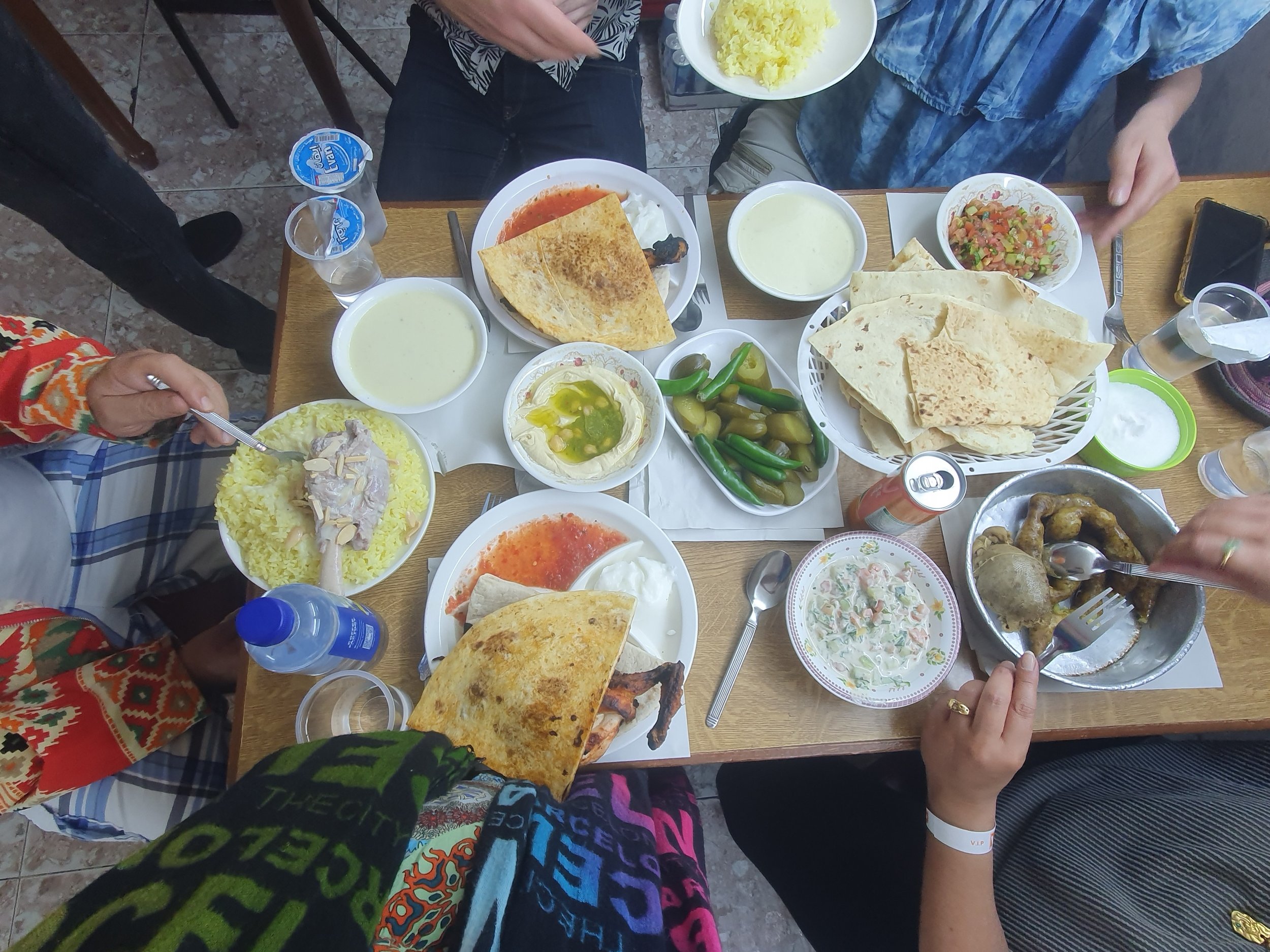
A classic spread of dips and dishes in Jordan - on the left, Jordan’s national dish, maqlouba. On the right, stuffed… insides… All choices in The Cairo Restaurant. It’s still worth the trip, even if you’re not feeling food-adventurous. There are plenty of good dishes without doing the exotic.
Mansaf – lamb or beef casserole stewed in sour milk, with spices – the Jordanian national food. Rich, but an amazing array of flavours! To serve, dish out over a steaming bed of rice to soak up the juices.
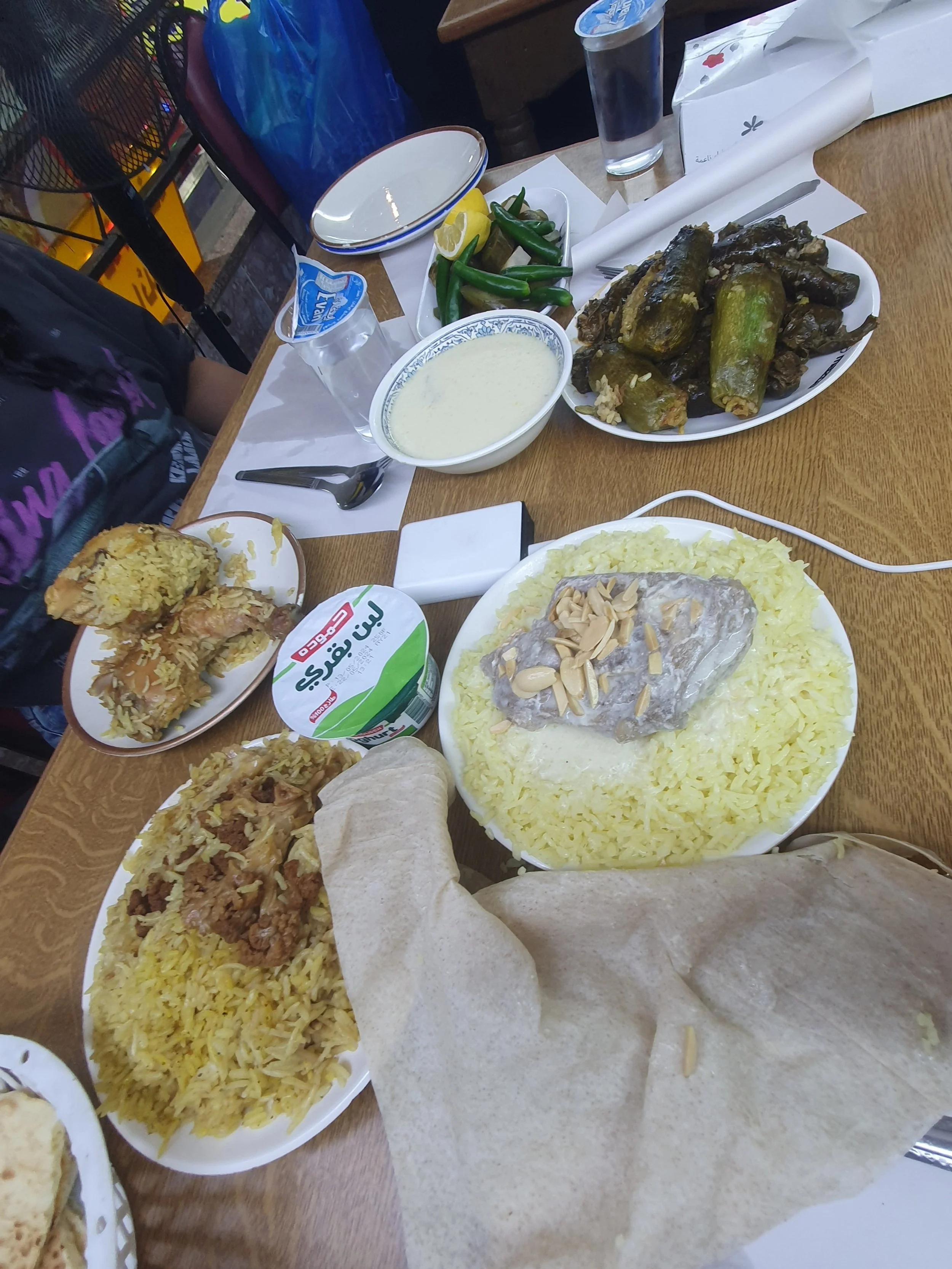
Maqlouba - stewed in sour milk with an exotic mix of spices, and topped with almond slivers.
Maqlouba – is a showpiece! It’s a rice dish with any variety of meat, all cooked together in one pot. Line the bottom with strips of grilled eggplant, peppers, tomatoes or potatoes. Fill with rice and cooked meat and cook without stirring, not unlike the Asian absorption method for rice. When it’s time to serve, the more of a show the better. Cover with the serving dish and turn upside down. Tap a few times, recite an abracadabra type spell (and maybe a quick prayer), then lift off the pot. You (hopefully) will have a ‘cake’ of rice and the decorative strips of vegetable, all caramalised and a major and delicious feast.
Molouqia – This one always makes me think of ‘Clan of the Cave Bear’ written by Jean M Auel many years ago. She was remarkable in researching the book and bringing to life a neolithic scenario from 10,000 years ago. I can imagine the medicine woman trying out this green herb to see if it was edible, and trying out different ways to cook it. In Jordan, it has ended up as a kind of sticky soup which is poured over chicken and rice. Add lashings of lemon juice, and this one is so yummy!
Then there is the myriad of sweets typically involving nuts.
Have you ever tried kunafah. Oh my! Get yourself a good one and this sweet desert is amazing. It is typically a slice including loads of honey and ground up almonds, but through the middle you also have cheese. Get yourself a slice – served warm of course - and the stretchy melty cheese in the middle will form strings from your fork. Just like a pizza, only this one is sweet.
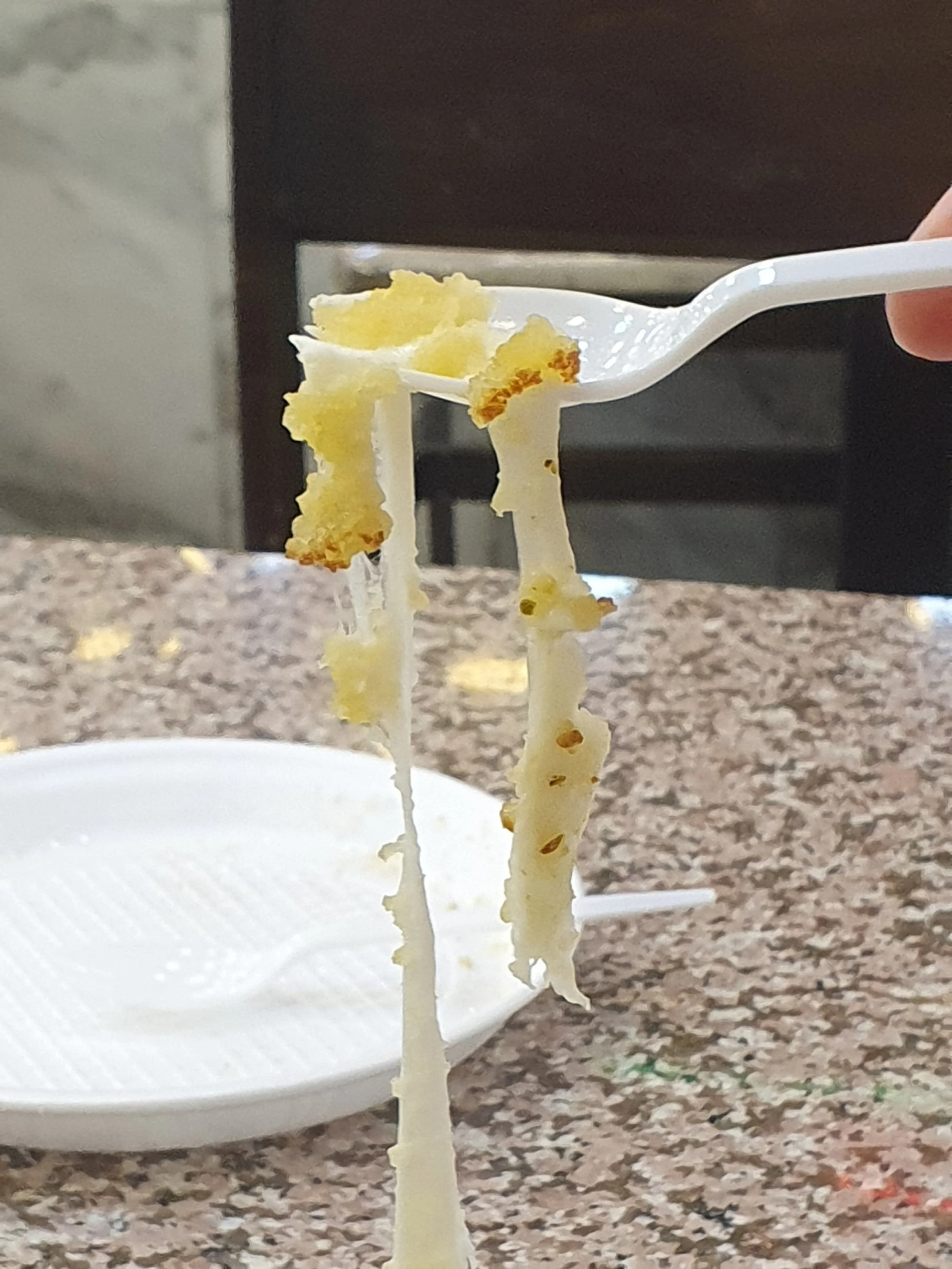
Kunafah - a warm mix of honey sweet and stretchy cheese, well worth tasting.
There is a place in downtown Amman on your way to the amphitheatre – yes, Amman still has an amphitheatre in the middle of downtown, with a museum of local culture, and where shows are still put on. Yes, something funny happened one day on the way to the forum…
Well, this tiny little shop which is just big enough to make the kunafah and serve it, doesn’t even have room for the cashier. He’s in a little stand just at the door in this small alleyway. And the customers…?
In testament to the quality of the kunafah here, there is typically a queue all the way out to the street and along it, maybe 20 people or more waiting at any one time for their slice. Those served perch on low walls unless lucky enough to score one of the chairs, to eat their treasure.
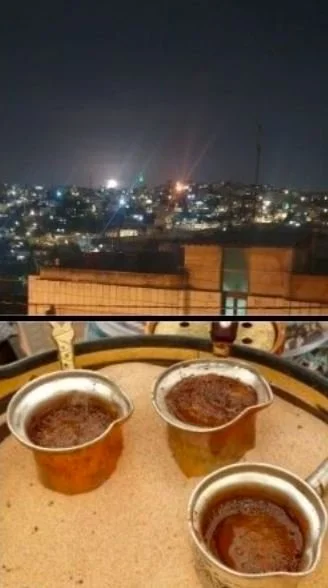
Bedouin coffee in Amman - like Turkish coffee but with cardamon.
Again, I have placed myself in inordinate danger. A mere 145 km from the trouble I have risked my waistline with the amazing food and too much kunafah. I have experienced history that dates back to Biblical times and beyond – way beyond. I have chilled with a view of downtown’s fairy lights. I have wandered through the markets and bargained over treats – usually to be given some samples on the way.
Don’t shy off these amazing Middle Eastern destinations because of exaggerated media reports. Jordan and Egypt are quite safe, and so full of exotic and wonderful sites and tastes. Without tourists, the locals struggle. Follow me.
I have stepped in the footprints that have walked this city for nearly 10,000 years. And I have barely touched the surface of this amazing country.
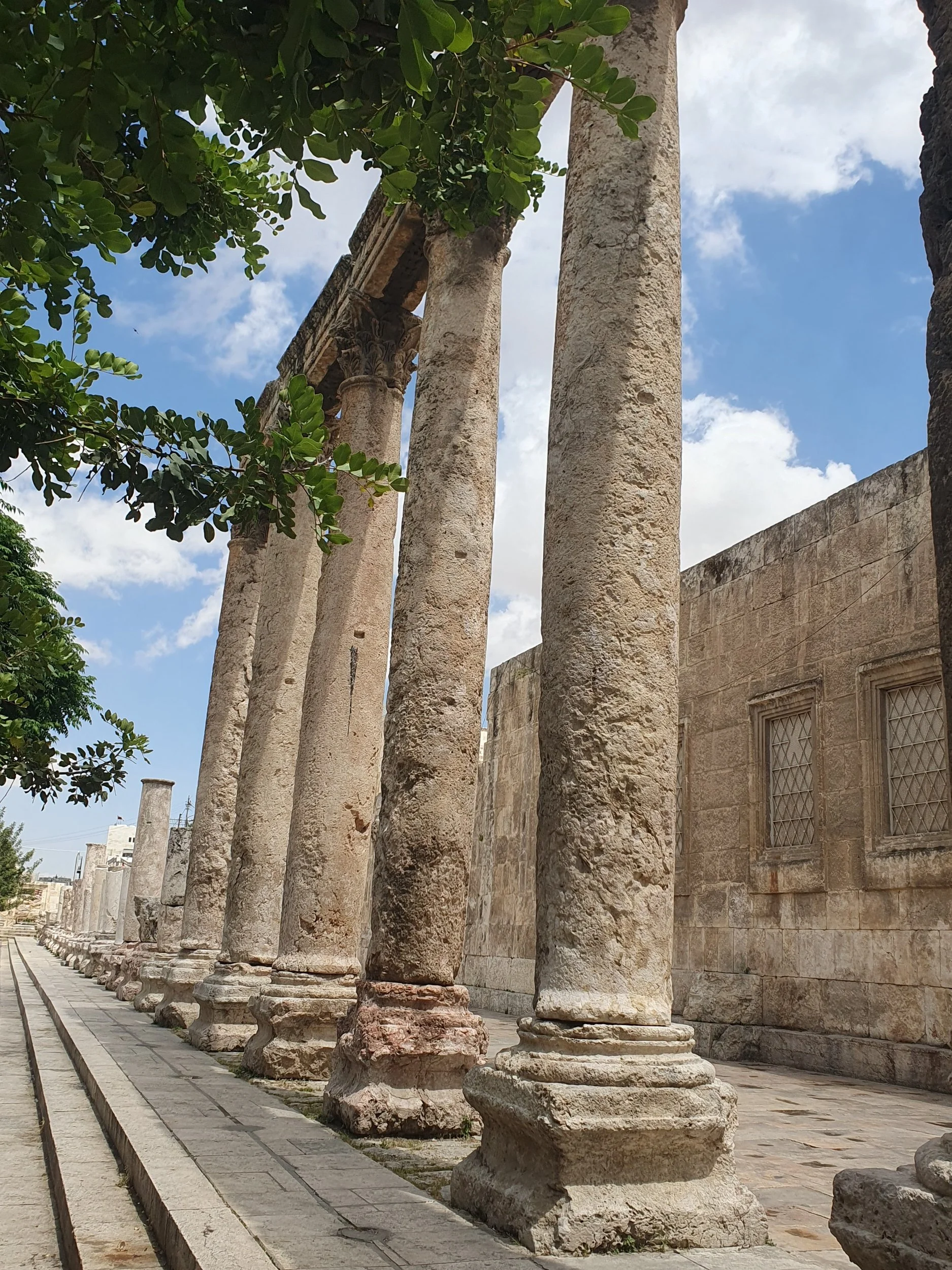
Downtown Amman isn’t just for shopping and kunafah… This is in front of its amphitheatre.